<?xml version="1.0" encoding="utf-8"?>
<feed xmlns="http://www.w3.org/2005/Atom">

    <title>Eli Richmond's Interesting Ideas</title>
    <link href="http://bloge.li/ideas"/>
    <updated>2002-11-26T18:30:02Z</updated>
    <author>
    <name>Eli Richmond</name>
    </author>
    <id>bloge.li</id>
    <logo>https://bloge.li/static/xi.png</logo>
    <icon>https://bloge.li/static/xi.png</icon>

    
        <entry>
            <id>https://bloge.li/ideas/2025-08-28</id>
            <link href="https://bloge.li/ideas/2025-08-28"/>
            <title>
                Don't Be A Damn Victim
            </title>
            <published>2025-08-28T00:00:00Z</published>
            <content type="html">
                <section id="idea">
<h2></h2>
<p>
                Just a video that has resonated recently as I'm trying to find some footing in the working work.
            </p>
<p id="original-link">
                See the original: <a href="https://www.youtube.com/watch?v=RgZmDk1NcOU" target="_blank">A Youtube video by Jordan Peterson</a>
</p>
<iframe allow="accelerometer; autoplay; clipboard-write; encrypted-media; gyroscope; picture-in-picture; web-share" allowfullscreen="" frameborder="0" height="315" referrerpolicy="strict-origin-when-cross-origin" src="https://www.youtube.com/embed/RgZmDk1NcOU?si=sVJTKVSiaoIEqSLa" title="YouTube video player" width="560"></iframe>
<time>
            
            </time>
</section>
            </content>
        </entry>
    
        <entry>
            <id>https://bloge.li/ideas/2025-08-22</id>
            <link href="https://bloge.li/ideas/2025-08-22"/>
            <title>
                You’re probably using the wrong dictionary
            </title>
            <published>2025-08-22T00:00:00Z</published>
            <content type="html">
                <section id="idea">
<h2></h2>
<p>
                TLDR;
                <ol>
<li>This is awesome.</li>
<li>Basically the dictionary you've been using sucks, and this one is wayyy better.</li>
<li>There are instructions to use this new, better dictionary on your computer, kindle, etc because that's the only way anyone will actually use it.</li>
</ol>
</p>
<p id="original-link">
                See the original: <a href="https://jsomers.net/blog/dictionary" target="_blank">A blog article by James Somers</a>
</p>
<small>I have copied the content from this post when I read it below, but if you want up-to-date instructions, you should probably go to the orginal link.</small>
<blockquote id="ideas-content">
<div class="entry-content">
<p>The way I thought you used a dictionary was that you looked up words you've never heard of, or whose sense you're unsure of. You would never look up an ordinary word -- like <em>example</em>, or <em>sport</em>, or <em>magic</em> -- because all you'll learn is what it means, and that you already know.</p>
<p>Indeed, if you look up those particular words in the dictionary that comes with your computer -- on my Mac, it's the <em>New Oxford American Dictionary, 3rd Edition</em> -- you'll be rewarded with... well, there won't be any reward. The entries are pedestrian:</p>
<p><strong>example</strong> /igˈzampəl/, n. <em>a thing characteristic of its kind or illustrating a general rule</em>.</p>
<p><strong>sport</strong> /spôrt/, n. <em>an activity involving physical exertion and skill in which an individual or team competes against another or others for entertainment</em>.</p>
<p><strong>magic</strong> /ˈmajik/, n. <em>the power of apparently influencing the course of events by using mysterious or supernatural forces</em>.</p>
<p>Here, words are boiled to their essence. But that essence is dry, functional, almost bureaucratically sapped of color or pop, like <a href="https://upload.wikimedia.org/wikipedia/commons/6/6f/Pruitt-Igoe-overview.jpg">high modernist architecture</a>. Which trains you to think of the dictionary as a utility, not a quarry of good things, not a place you'd go to explore and savor.</p>
<p>Worse, the words themselves take on the character of their definitions: they are likewise reduced. A delightful word like "fustian" -- delightful because of what it means, because of the way it looks and sounds, because it is unusual in regular speech but not so effete as to be unusable, is described, efficiently, as "pompous or pretentious speech or writing." Not only is this definition (as we'll see in a minute) simplistic and basically wrong, it's just not in the same class, English-wise, as "fustian." The language is tin-eared and uninspired. It's criminal: This is the place where all the words live and the writing's no good.</p>
<p>The New Oxford American dictionary, by the way, is not like singularly bad. Google's dictionary, the modern Merriam-Webster, the dictionary at dictionary.com: they're all like this. They're all a chore to read. There's no play, no delight in the language. The definitions are these desiccated little husks of technocratic meaningese, as if a word were no more than its coordinates in semantic space.</p>
<h3>John McPhee's secret weapon</h3>
<p>John McPhee -- one the great American writers of nonfiction, almost peerless as a prose stylist -- once wrote an essay for the New Yorker about his process called "<a href="https://jsomers.net/mcphee-draft-no-4.pdf">Draft #4</a>." He explains that for him, draft #4 is the draft after the painstaking labor of creation is done, when all that's left is to punch up the language, to replace shopworn words and phrases with stuff that sings.</p>
<p>The way you do it, he says, is "you draw a box not only around any word that does not seem quite right but also around words that fulfill their assignment but seem to present an opportunity." You go looking for <em>le mot juste</em>.</p>
<p>But where?</p>
<p>"Your destination is the dictionary," he writes:</p>
<blockquote>
<p>Suppose you sense an opportunity beyond the word "intention." You read the dictionary's thesaurian list of synonyms: "intention, intent, purpose, design, aim, end, object, objective, goal." But the dictionary doesn't let it go at that. It goes on to tell you the differences all the way down the line -- how each listed word differs from all the others. Some dictionaries keep themselves trim by just listing synonyms and not going on to make distinctions. You want the first kind, in which you are not just getting a list of words; you are being told the differences in their hues, as if you were looking at the stripes in an awning, each of a subtly different green.</p>
</blockquote>
<p>I do not have this first kind of dictionary. In fact I would have never thought to use a dictionary the way McPhee uses his, and the simple reason is that I've never had a dictionary <em>worth</em> using that way. If you were to look up the word "intention" in my dictionary here's all you would see: "a thing intended; an aim or plan." No, I don't think I'll be punching up my prose with that.</p>
<p>But somehow for McPhee, the dictionary -- the dictionary! -- was the fount of fine prose, the first place he'd go to filch a phrase, to steal fire from the gods. So for instance he'd have an idea of something he wanted to say:</p>
<blockquote>
<p>I grew up in canoes on northern lakes. Thirty years later, I was trying to choose a word or words that would explain why anyone in a modern nation would choose to go a long distance by canoe. I was damned if I was going to call it a sport, but nothing else occurred.</p>
</blockquote>
<p>And he'd go, Well, "sport" is kind of clunky, it's kind of humdrum. Maybe I can do better. And he'd look up "sport," and instead of the even more hopelessly banal "an activity involving physical exertion and skill" that I'd get out of my dictionary, he'd discover this lovely chip of prose: "2. A diversion of the field." Thus he could write:</p>
<blockquote>
<p>His professed criteria were to take it easy, see some wildlife, and travel light with his bark canoes -- nothing more -- and one could not help but lean his way... Travel by canoe is not a necessity, and will nevermore be the most efficient way to get from one region to another, or even from one lake to another -- anywhere. A canoe trip has become simply a rite of oneness with certain terrain, a diversion of the field, an act performed not because it is necessary but because there is value in the act itself.</p>
</blockquote>
<p>A book where you can enter "sport" and end up with "a diversion of the field" -- this is in fact the opposite of what I'd known a dictionary to be. This is a book that transmutes plain words into language that's finer and more vivid and sometimes more rare. No wonder McPhee wrote with it by his side. No wonder he looked up words he knew, versus words he didn't, in a ratio of "at least ninety-nine to one."</p>
<p>Unfortunately, he never comes out and says exactly which dictionary he's getting all this juice out of. But I was desperate to find it. What was this secret book, this dictionary so rich and alive that one of my favorite writers was using it to make heroic improvements to his writing?</p>
<p>I did a little sleuthing. It wasn't so hard with the examples McPhee gives, and Google. He says, for instance, that in three years of research for a book about Alaska he'd forgotten to look up the word <em>Arctic</em>. He said that his dictionary gave him this: "Pertaining to, or situated under, the northern constellation called the Bear."</p>
<p>And that turned out to be enough to find it.</p>
<h3>The invention of American English</h3>
<p>Noah Webster is not the best-known of the Founding Fathers but he has been called "the father of American scholarship and education." There's actually this great <a href="https://en.wikipedia.org/wiki/Noah_Webster#Blue_Backed_Speller">history</a> of how he almost singlehandedly invented the very idea of <em>American</em> English, defining the native tongue of the new republic, "rescuing" it from "the clamour of pedantry" imposed by the Brits.</p>
<p>He developed a book, the Blue Backed Speller, which was meant to be something of a complete linguistic education for young American kids, teaching them in easy increments how to read, spell, and pronounce words, and bringing them up on a balanced diet of great writing. It succeeded. It was actually the most popular book of its time; by 1890 it had sold 60 million copies.</p>
<p>But that wasn't even Webster's most ambitious project. Certainly it's not what he became known for. In 1807, he started writing a dictionary, which he called, boldly, <em>An American Dictionary of the English Language</em>. He wanted it to be comprehensive, authoritative. Think of that: a man sits down, aiming to capture his language whole.</p>
<p>Dictionaries today are not written this way. In fact it'd be strange even to say that they're <em>written</em>. They are <em>built</em> by a large team, less a work of art than of engineering. When you read an entry you don't get the sense that a person labored at his desk, alone, trying to put the essence of that word into words. That is, you don't get a sense, the way you do from a good novel, that there was another mind as alive as yours on the other side of the page.</p>
<p>Webster's dictionary took him 26 years to finish. It ended up having 70,000 words. He wrote it all himself, including the etymologies, which required that he learn 28 languages, including Old English, Gothic, German, Greek, Latin, Italian, Spanish, Dutch, Welsh, Russian, Aramaic, Persian, Arabic, and Sanskrit. He was plagued by debt to fund the project; he had to mortgage his home.</p>
<p>In his own lifetime the dictionary sold poorly and got little recognition. Today, of course, his name is so synonymous with even the idea of a dictionary that <em>Webster</em> is actually a <a href="https://en.wikipedia.org/wiki/Genericized_trademark">genericized trademark</a> in the U.S., so that other dictionaries <em>whose contents bear no relation to Webster's original</em> can <a href="https://en.wikipedia.org/wiki/Webster's_Dictionary#The_name_Webster_used_by_others">use</a> the name just to have the "Webster" brand rub off on them. [1]</p>
<p style="text-align: center; margin:0 auto; margin-bottom: 10px;">* * *</p>
<p>It makes sense: there was, and is, something remarkable about his 1828 dictionary, and the editions that followed in its line (the New and Revised 1847, the Unabridged 1864, the International 1890 and 1900, the New International 1909, the 1913, etc.). You can see why it became cliché to start a speech with "Webster's defines X as...": with his dictionary the definition that followed was actually likely to lend gravitas to your remarks, to sound so good, in fact, that it'd beat anything you could come up with on your own.</p>
<p>Take a simple word, like "flash." In all the dictionaries I've ever known, I would have never looked up that word. I'd've had no reason to -- I already knew what it meant. But go <a href="https://web.archive.org/web/20160108161120/http://machaut.uchicago.edu:80/websters">look up "flash" in Webster's</a> (the edition I'm using is the 1913). The first thing you'll notice is that the example sentences don't sound like they came out of a DMV training manual ("the lights started flashing") -- they come from Milton and Shakespeare and Tennyson ("A thought flashed through me, which I clothed in act").</p>
<p>You'll find a sense of the word that is somehow more evocative than any you've seen. "2. To convey as by a flash... as, to flash a message along the wires; to flash conviction on the mind." In the juxtaposition of those two examples -- a message transmitted by wires; a feeling that comes suddenly to mind -- is a beautiful analogy, worth dwelling on, and savoring. Listen to that phrase: "to flash conviction on the mind." This is in a <em>dictionary</em>, for God's sake.</p>
<p>And, toward the bottom of the entry, as McPhee promised, is a usage note, explaining the fine differences in meaning between words in the penumbra of "flash":</p>
<blockquote>
<p>... Flashing differs from exploding or disploding in not being accompanied with a loud report. To glisten, or glister, is to shine with a soft and fitful luster, as eyes suffused with tears, or flowers wet with dew.</p>
</blockquote>
<p>Did you see that last clause? "To shine with a soft and fitful luster, as eyes suffused with tears, or flowers wet with dew." I'm not sure why you won't find writing like that in dictionaries these days, but you won't. Here is the modern equivalent of that sentence in the latest edition of the Merriam-Webster: "glisten applies to the soft sparkle from a wet or oily surface &lt;glistening wet sidewalk&gt;."</p>
<p>Who decided that the American public couldn't handle "a soft and fitful luster"? I can't help but think something has been lost. "A soft sparkle from a wet or oily surface" doesn't just sound worse, it actually describes the phenomenon with less precision. In particular it misses the shimmeriness, the micro movement and action, "the <em>fitful</em> luster," of, for example, an eye full of tears -- which is by the way far more intense and interesting an image than "a wet sidewalk."</p>
<p>It's as if someone decided that dictionaries these days had to sound like they were written by a Xerox machine, not a person, certainly not a person with a poet's ear, a man capable of high and mighty English, who set out to write the secular American equivalent of the King James Bible and pulled it off.</p>
<h3>Words worth using</h3>
<p>I don't want you to conclude that it's just a matter of aesthetics. Yes, Webster's definitions are prettier. But they are also better. In fact they're so much better that to use another dictionary is to keep yourself forever at arm's length from the actual language.</p>
<p>Recall that the New Oxford, for the word "fustian," gives "pompous or pretentious speech or writing." I said earlier that that wasn't even really correct. Here, then, is Webster's definition: "An inflated style of writing; a kind of writing in which high-sounding words are used, above the dignity of the thoughts or subject; bombast." Do you see the difference? What makes fustian fustian is not just that the language is pompous -- it's that this pomposity is <em>above the dignity of the thoughts or subject</em>. It's using fancy language where fancy language isn't called for.</p>
<p>It's a subtle difference, but that's the whole point: English is an awfully subtle instrument. A dictionary that ignores these little shades is dangerous; in fact in those cases it's worse than useless. It's misleading, deflating. It divests those words of their worth and purpose.</p>
<p>Take "pathos." This is one of those words I used to keep looking up because I kept forgetting what it meant -- and every time I'd go to the dictionary I would get this terse, limiting definition: "a quality that evokes pity or sadness." Not much there to grab a hold of. I'd wonder, Is that really all there is to pathos? It had always seemed a grander word than that. But this was the dictionary, and whatever it declared was final.</p>
<p>Final, that is, until I discovered Webster:</p>
<p><strong>pathos</strong> /ˈpāˌTHäs/, n. <em>1. The quality or character of those emotions, traits, or experiences which are personal, and therefore restricted and evanescent; transitory and idiosyncratic dispositions or feelings as distinguished from those which are universal and deep-seated in character; -- opposed to <strong>ethos</strong>.</em></p>
<p>It continued. <em>2. That quality or property of anything which touches the feelings or excites emotions and passions, esp., that which awakens tender emotions, such as pity, sorrow, and the like; contagious warmth of feeling, action, or expression; pathetic quality; as, the pathos of a picture, of a poem, or of a cry.</em></p>
<p>Dear god! How did I not know about this dictionary? How could you even <em>call</em> yourself a dictionary if all you give for "pathos" is "a quality that evokes pity or sadness"? Webster's definition is so much fuller, so much closer to felt experience.</p>
<p>Notice, too, how much less certain the Webster definition seems about itself, even though it's more complete -- as if to remind you that the word came first, that the word isn't <em>defined</em> by its definition here, in this humble dictionary, that definitions grasp, tentatively, at words, but that what words really are is this haze and halo of associations and evocations, a little networked cloud of uses and contexts.</p>
<p>What I mean is that with its blunt authority the New Oxford definition of "pathos" -- "a quality that evokes pity or sadness" -- shuts down the conversation, it shuts down your thinking about the word, while the Webster's version gets your wheels turning: it seems so much more provisional -- "that which awakens tender emotions, such as pity, sorrow, and the like; contagious warmth of feeling, action, or expression; pathetic quality; as, the pathos of a picture, of a poem, or of a cry" -- and therefore alive.</p>
<p>Most important, it describes a word worth using: a mere six letters that have come to stand for something huge, for a complex meta-emotion with mythic roots. Such is the power of actual English.</p>
<h3>The pleasure of finding things out</h3>
<p>I could go on forever listing examples. I could say, "Look up <em>example</em>, <em>magic</em>, <em>sport</em>. Look up <em>arduous</em>, <em>huge</em>, <em>chauvinistic</em>, <em>venal</em>, <em>pell-mell</em>, <em>raiment</em>, <em>sue</em>, <em>smarting</em>, <em>stereotype</em>. Look up the word <em>word</em>, and <em>look</em>, and <em>up</em>. Look up every word you used today." Indeed that's what motivated this post: I'd been using Webster's dictionary for about a year; I kept looking words up, first there, then in whatever modern dictionary was closest to hand, and seeing this awful difference, evidence of a crime that kept piling up in my mind, the guilt building: so many people were getting this wrong impression about words, every day, so many times a day.</p>
<p>There's an amazing thing that happens when you start using the right dictionary. Knowing that it's there for you, you start looking up more words, including words you already know. And you develop an affection for even those, the plainest most everyday words, because you see them treated with the same respect awarded to the rare ones, the high-sounding ones.</p>
<p>Which is to say you get a feeling about English that Calvin once got with his pet tiger on a day of fresh-fallen snow: "It's a magical world, Hobbes. Let's go exploring!"</p>
<h3>Appendix: How to start using Webster's 1913 dictionary on your Mac, iPhone, Android, and Kindle</h3>
<p>The closest thing you can get to a plain-text, easily hackable, free, out-of-copyright version of the dictionary McPhee probably used is <a href="https://web.archive.org/web/20160108161120/http://machaut.uchicago.edu:80/websters">Webster's Revised Unabridged Dictionary (1913 + 1828)</a>.</p>
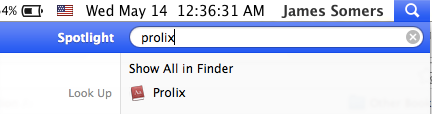
<p>You'll never use it, though, unless it's built in to your computer and available easily on your phone and e-reader. For instance I wanted it so that whenever I typed a word into Spotlight, I'd get a Webster's definition:</p>
<p><a href="https://jsomers.net/blog/wp-content/uploads/2014/05/first.png"><img alt="spotlight" class="alignnone size-full wp-image-1147" decoding="async" height="114" sizes="(max-width: 432px) 100vw, 432px" src="https://jsomers.net/blog/wp-content/uploads/2014/05/first.png" srcset="https://jsomers.net/blog/wp-content/uploads/2014/05/first.png 432w, https://jsomers.net/blog/wp-content/uploads/2014/05/first-300x79.png 300w" width="432"/></a></p>
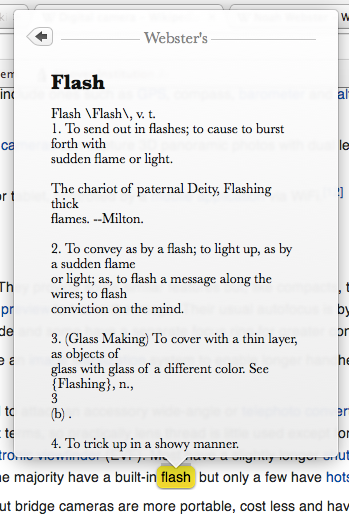
<p>I even wanted it so that when I highlighted a word in my browser, and hit Cmd + Ctrl + D, I'd see a definition from Webster's:</p>
<p><a href="https://jsomers.net/blog/wp-content/uploads/2014/05/second.png"><img alt="inline" class="alignnone size-full wp-image-1146" decoding="async" fetchpriority="high" height="514" sizes="(max-width: 349px) 100vw, 349px" src="https://jsomers.net/blog/wp-content/uploads/2014/05/second.png" srcset="https://jsomers.net/blog/wp-content/uploads/2014/05/second.png 349w, https://jsomers.net/blog/wp-content/uploads/2014/05/second-203x300.png 203w" width="349"/></a></p>
<p>Here's how I got that to work:</p>
<ul>
<li>Download <a href="https://s3.amazonaws.com/jsomers/dictionary.zip">this archive from S3</a>.</li>
<li>Unzip it and launch the DictUnifier app.</li>
<li>Drag the <code>stardict-dictd-web1913-2.4.2.tar.bz2</code> file, still compressed, onto that app's little drag-and-drop area. It might take a few seconds before the conversion process starts. Once it does, it'll take about 30 minutes to finish.</li>
<li>The dictionary will now be available in your Dictionary app. (If not, you may need to enable it in the app's Preferences pane, as <a href="https://cloud.githubusercontent.com/assets/21294/3085216/6b3463ae-e50b-11e3-822d-a59765748865.png">here</a>.) But its formatting may look a little off. If the lines are squished together, open  <code>~/Library/Dictionaries/dictd_www.dict.org_web1913.dictionary/Contents/DefaultStyle.css</code> in a text editor and add the following directive:</li>
</ul>
<div class="highlight highlight-css"><pre><span class="nt">p</span> <span class="p">{</span> <span class="k">line-height</span><span class="o">:</span> <span class="m">0.7em</span> <span class="p">}</span>
</pre></div>
<p>Restart the Dictionary app to confirm that the CSS was updated correctly. (You might also try bumping the <code>margin-top</code> and <code>margin-bottom</code> values in the <code>div.y</code> block to 0.7em, from 0.5em. And some folks have said that 1em works better than 0.7em.)</p>
<ul>
<li>If you're on a new M1 Mac with the Monterey OS, follow these instructions:

<ol>
<li>This GitHub Link has a "Just want the Dictionary?" section that links to the .dictionary folder on the releases page in GitHub: https://github.com/ponychicken/WebsterParser</li>
<li>Dictionary --&gt; File --&gt; Open Dictionaries Folder, and then, in Finder, dragging the downloaded "Websters-1913.dictionary" file into the folder, and then Dictionary --&gt; Dictionary --&gt; Preferences, checking the now last dictionary in the list, and dragging it to the top, gets the job done.</li>
</ol></li>
<li>If you want to always see Webster's results by default, go to the Dictionary app's preferences and drag Webster's to the top of the list.</li>
<li>If you're on OS X Lion, follow <a href="http://apple.stackexchange.com/questions/22897/how-to-place-dictionary-definitions-higher-up-in-spotlight-results">these instructions</a> so that Dictionary results appear first in Spotlight searches.</li>
<li>If you're unhappy with the formatting of the entries in Dictionary, <a href="https://github.com/aparks517/convert-websters">here</a> are alternative instructions for setting up Webster's on OS X that may give better results. (<a href="https://github.com/DieBuche/WebsterParser">Here</a>, too.)</li>
<li>To get it on your iPhone, get the Stardict-compatible <a href="https://itunes.apple.com/us/app/dictionary-universal/id312088272?mt=8">Dictionary</a> app. On its installation screen, go to the "Network" tab and type <code>https://emw3.com/stardict-dictd-web1913-2.4.2.tar.bz2</code>, exactly, into the URL bar. (Alternatively, just download <a href="http://itunes.apple.com/app/id943993346">this free app</a> by Aaron Parks.)</li>
<li>For Android, you can follow <a href="https://gist.github.com/jsomers/9dd78c8dc7fab071993c">these instructions</a>, courtesy of <a href="https://twitter.com/TheRealPlato">@TheRealPlato</a>.</li>
<li>To add the dictionary as a search engine on Chrome, follow <a href="https://gist.github.com/jsomers/60159ee970d6dee86aa2">these instructions</a>, courtesy of <a href="https://twitter.com/chancelionheart">@chancelionheart</a>.</li>
<li>And finally, <a href="https://gist.github.com/jsomers/4236a2770a51e0b24900">follow these instructions</a> to get the dictionary on your Kindle.</li>
</ul>
<h3>Notes</h3>
<p>[1] Note that the modern Merriam-Webster, even though it does derive directly from Webster's original, has been revised so much that it's actually <em>less</em> similar, content-wise, than some of the impostors. It, too, is one of the "wrong" dictionaries.</p>
</div>
</blockquote>
<time>
                
            </time>
</section>
            </content>
        </entry>
    
        <entry>
            <id>https://bloge.li/ideas/2025-08-06</id>
            <link href="https://bloge.li/ideas/2025-08-06"/>
            <title>
                Digital hygiene: Notifications
            </title>
            <published>2025-08-06T00:00:00Z</published>
            <content type="html">
                <section id="idea">
<h2></h2>
<p>
                Herman is the creator of <a href="bearblog.dev" target="_blank">bearblog.dev</a>, a wonderfully minimalistic blogging platform.
                He certainly shares most of my digital values, and this is a fantastic article on managing phone notifications that I have coincidentally been doing for years.
            </p>
<p id="original-link">
                See the original: <a href="https://herman.bearblog.dev/notifications/" target="_blank">A blog article by Herman Martinus</a>
</p>
<main>
<blockquote id="ideas-content">
<style>
                    strong {
                        font-size: 125%;
                        font-weight: 1000;
                        font-family: Nexa;
                    }
                </style>
<p><em>This is part 2 of a 3 part series on digital hygiene. I suggest starting at <a href="https://herman.bearblog.dev/digital-hygiene-emails/">part 1</a>.</em></p>
<p>Over the past few years I've cultivated a decent relationship with my phone. Not a good one, mind you, but one I'm fairly comfortable with. There is a part of me that yearns for a return to simple, black-and-white phones, with Internet access limited to whichever room in the house had the phone line and computer. But there's no going back; and so I had to find a way to live with the Internet (and the hyper-connectivity it entails) in my pocket.</p>
<p>Developing a good relationship to your phone is an intentional process. It doesn't happen by accident. All apps and media, by design, are fighting for your attention. I've heard the term "attention economy" thrown around, and I feel like it's an apt description of the battle for our increasingly fractured attentions.</p>
<p>And the easiest way to grab your attention is via notifications.</p>
<p>Sometimes I see a person's phone covered in notifications and I get anxiety-by-proxy. Red toasts in the triple-digits; the notification bar an endless list of banners, messages, friend requests, and marketing content. I can't imagine this is a pleasant experience, but it seems to be the norm.</p>
<p>In my opinion, notifications need to be reeled in as a priority. At the end of the day my phone is a tool. I want to choose how to use it. I don't want it to "keep me engaged" or sell me things. I want to own my own time, and have full control of my attention.</p>
<p>A more utilitarian reason to get notifications under control is that when all notifications are active, none of them are. When I use the Reminders app on my iPhone I <em>actually want to be reminded of something</em>, instead of that notification being buried beneath unimportant stuff.</p>
<p>Here's the method I used for breaking free of notification hell (you'll notice a lot of overlap with my previous post on emails):</p>
<p><strong>1. Remove social media apps (or completely mute them at the very least)</strong></p>
<p>I don't have traditional social media (think Instagram, Facebook, Twitter, or LinkedIn). I've <a href="https://herman.bearblog.dev/quitting-social-media/">written</a> about it before. But in a nutshell, these apps consume my time and energy without giving me much value in return. Instead I try to nurture in-person relationships, or use longer-form digital communication, like calls or email.</p>
<p>Regardless of my personal preferences around <em>having social media</em>, it goes without saying that those apps should, at the very least, be muted. No banners, no toasts, no sounds. It should be up to you when to engage with these platforms; because if left up to them you would never log off. Another way to manage this is to put social media apps on a separate device, like an iPad left at home, which takes this pernicious time-suck out of your pocket.</p>
<p>If you're trying to smoke less, don't carry a box of cigarettes around with you.</p>
<p><strong>2. Opt-in instead of opt-out notifications</strong></p>
<p>A simple but effective way of cleaning up phone notifications is to go and turn them all off, then selectively turn on the ones you actually need. The idea is that all notifications should be opt-in, instead of opt-out. Notifications should also be set to the least-intrusive method, depending on the application. For example, here are my only notifications on my phone:</p>
<ul class="bb">
<li>Messaging apps (Telegram, WhatsApp, Messages)<ul>
<li>✅ Toasts</li>
<li>❌ Banners</li>
<li>❌ Sounds</li>
</ul>
</li>
<li>Phone calls<ul>
<li>❌ Toasts</li>
<li>✅ Banners</li>
<li>✅ Sounds</li>
</ul>
</li>
<li>Calendar and reminders<ul>
<li>✅ Toasts</li>
<li>✅ Banners</li>
<li>✅ Sounds</li>
</ul>
</li>
<li>Uptime monitor<ul>
<li>❌ Toasts</li>
<li>✅ Banners</li>
<li>✅ Sounds</li>
</ul>
</li>
<li>RSS reader<ul>
<li>✅ Toasts</li>
<li>❌ Banners</li>
<li>❌ Sounds</li>
</ul>
</li>
</ul>
<p>Everything else is left turned off, since most things aren't time sensitive. I used to have Uber's notifications turned on, since I didn't want to miss my ride, but found that Uber doesn't respect marketing opt-out and would send me "special offers" that were impossible to turn off. Now I just make sure I don't forget that I've ordered an Uber.</p>
<p>With group-chats on messaging apps (which can become overwhelming), I mute all of the ones that have a lot of noise and archive them; checking them every now and then.</p>
<p><strong>3. Managing sounds</strong></p>
<p>Sounds and vibrations are the worst kinds of notifications since they grab your attention even when not using your device. Because of this you'll notice that only calls, calendar and reminders, and uptime monitors have sounds enabled, since these are the time sensitive ones. But even then I still have sleep mode active after 7pm, so only my uptime monitor and repeat phone calls get through.</p>
<p><strong>4. Report telemarketers and robo-calls</strong></p>
<p>In South Africa we have a public National Opt-Out Register (you may have something like this in your jurisdiction). This can be used by companies to determine if you're open to direct marketing communications. When I receive a marketing call from a company, if it's a human I politely ask them to remove my number from their marketing list. If I receive another call from that company (or any robo-call) I report them to the Information Regulator of South Africa for processing my personal importation without my consent, as well as not respecting the National Opt-Out Register. I then leave a <a href="https://www.hellopeter.com/metropolitan-life/reviews/robo-calls-and-harassment-5795160" target="_blank">public</a> <a href="https://www.hellopeter.com/dial-a-bed/reviews/breaking-information-privacy-law-5414191" target="_blank">review</a> <a href="https://www.hellopeter.com/cell-c/reviews/cell-c-illegally-spamming-me-and-refusing-to-stop-3809770" target="_blank">for</a> <a href="https://www.hellopeter.com/discovery-insure/reviews/marketing-communications-in-contravention-of-popia-5533815" target="_blank">that</a> company stating that they've broken the law by contacting me.</p>
<p>I'm very careful to never opt-in to any marketing communications, so I can say with certainty that any direct marketing I receive is definitively against privacy legislation where I live.</p>
<p>This has proven to be <strong>very</strong> effective. I have not received a single robo-call or direct marketing call in the past few months. It may seem like a lot of work up front, but it pays dividends since I never get pulled out of whatever I'm doing just to answer a call from a company I don't care about. It's also punishment for them trying to advertise to me in the privacy of my own home. That feels like crossing a boundary.</p>
<p>All of this applies to the computer as well. I don't allow any banners to pop-up on my computer, which easily pull me out of work. Slack only shows a red small toast (sans the number) to let me know there's an unread mesage, and even then the sidebar on my Mac is hidden by default. Your mileage may vary, depending on the work you do, but protecting deep work is important. At least to me.</p>
<p>So why all of this effort? I try to live an intentional and present life. I want to be <strong>here</strong> right now. Technology isn't going to regress back to the 90s and so we need to cultivate good relationships with our devices, so we can cultivate a good relationship with ourselves and the people around us.</p>
<p>Take back your attention.</p>
</blockquote>
<small>
            
            </small>
</main></section>
            </content>
        </entry>
    
        <entry>
            <id>https://bloge.li/ideas/2025-06-11</id>
            <link href="https://bloge.li/ideas/2025-06-11"/>
            <title>
                The Unreality of Pro Wrestling
            </title>
            <published>2025-06-11T00:00:00Z</published>
            <content type="html">
                <section id="idea">
<h2></h2>
<p>
                On a Joe Rogan podcast Rick Rubin dropped the single most intriguing and confusing statement I'd ever heard: <blockquote>"I believe wrestling is more real than reality."</blockquote>
</p>
<p>
                For a few years all I could do was guess at what Rick meant by this. Despite going to the internet for more information, he didn't have any other public conversations that touched on this at the time.
            </p>
<p>
                I watched pro wrestling trying to understand what Rick saw. I still couldn't understand; it was just silly, fake wrestling... until I found this crazy, mind-bending Youtube video.
            </p>
<p>
                To me this video captures the "Unreality" of life if pro wrestling is looked at like a mirror of reality rather than entirely fake version of it. You'll better understand what Rick meant and take home an important lession in skepticism about the truths we are presented with in day-to-day life. I strongly encourage you to give this video a chance.
            </p>
<p>
                Recently I found Rick's more direct take on pro wrestling, and I'll leave you with this quote before stepping into this amazing film.
            </p>
<p>
<blockquote>"There are countless situations in life where the truth is unclear and it is hard to tell what is real vs scripted."</blockquote>
</p>
<p id="original-link">
                See the original: <a href="https://www.youtube.com/watch?v=POsvxBJfTwg&amp;ab_channel=SuperEyepatchWolf" target="_blank">A Youtube video by Super Eyepatch Wolf</a>
</p>
<iframe allow="accelerometer; autoplay; clipboard-write; encrypted-media; gyroscope; picture-in-picture; web-share" allowfullscreen="" frameborder="0" height="315" referrerpolicy="strict-origin-when-cross-origin" src="https://www.youtube.com/embed/POsvxBJfTwg?si=rmMOpa--yBnvoHPd" title="YouTube video player" width="560"></iframe>
<small>
            
            </small>
</section>
            </content>
        </entry>
    
        <entry>
            <id>https://bloge.li/ideas/2025-05-23</id>
            <link href="https://bloge.li/ideas/2025-05-23"/>
            <title>
                The Airbnb Story
            </title>
            <published>2025-05-23T00:00:00Z</published>
            <content type="html">
                <section id="idea">
<h2></h2>
<p>
                Brain Chesky has one of the craziest start-up stories.
            </p>
<p id="original-link">
                See the original: <a href="https://www.startups.com/founder-interviews/brian-chesky" target="_blank">A blog article on Startups.com</a>
</p>
<blockquote id="ideas-content">
<div class="sco-1cewsk4">
<div class="sco-9myify">
<p class="dropcap">Brian Chesky’s dad wasn’t thrilled he had decided to go to art school. Chesky promised him he
                            would not move back home to live in their basement, and that when he was done, he’d get a real job with
                            health care benefits.</p>
<p>And he did. But at age 22 he was overcome by a “weird feeling of mortality.” A sense of “this is my life”:
                            Commuting in LA traffic alone to a job in a design company. It was a let down after he’d started to believe
                            the high-minded rhetoric from Rhode Island School of Design that designers could “design the world around
                            them.”</p>
<p>He quit that job, rolled up a foam bed into his crappy Honda Civic and moved in with his old design pal Joe
                            Gebbia in San Francisco. In a bid to pay rent, they opened up their home to attendees of a design conference
                            coming to town.</p>
<p>Most profiles will tell you that “the rest is history.” But that skips over the best part of the <a class="sco-0" href="https://www.airbnb.com/" node="[object Object]" target="_blank">Airbnb</a> CEO’s
                            story. So, back in 2013, I sat down with Brian to discuss the sheer insanity that stood in between that
                            “aha!” moment of Airbnb and anyone in Silicon Valley wanting to fund this thing.</p>
<p>Airbnb absolutely should have died long before it got close to Y-Combinator. Why they didn’t is a story of
                            $40,000 in maxed out credit cards, dozens of rejections, a lost cell signal that almost tanked the company,
                            burned fingers, a high fiber diet of “Cap’n McCains”, everyone around him thinking he was nuts.</p>
<p>No matter how screwed your startup may seem, the early days of Airbnb was even worse.</p>
<hr/>
<h3><strong>Sarah Lacy:</strong>  I don’t know if this is true or on urban legend, but did you used to
                                be a bodybuilder?</h3>
<p style="padding-left:45px"><strong>Brian Chesky:</strong>  <em>When I was at RISD, I wanted to also
                                pursue some sort of sports, and we didn’t have very many sports, so I just started weightlifting.</em>
</p>
<p style="padding-left:45px"><em>I like to say that I’ve lived like a number of lives. The first life was as a
                                hockey player, second life was as an artist. Then, for a period of time, I was a bodybuilder, then I was
                                an industrial designer. Now, here I am as an entrepreneur.</em></p>
<h3><strong>SL:</strong>  You would compete and just go somewhere in a Speedo, get oiled up and flex.
                        </h3>
<p style="padding-left:45px"><strong>BC:  </strong><em>Yeah. It’s all on the Internet. I did this before I
                                realized the consequences of the Internet, and so here I am.</em></p>
<h3><strong>SL:  </strong>You’re a cautionary tale. Other than mocking you, I bring up the bodybuilder
                            thing, because, you are different from the typical Silicon Valley CEO in a lot of ways.</h3>
<p style="padding-left:45px"><strong>BC:  </strong><em>Our backgrounds were considered a liability when I
                                got here. A lot of investors did not want to invest in us because of who I was.</em></p>
<h3><strong>SL:  </strong>A bodybuilder.</h3>
<p style="padding-left:45px"><strong>BC:</strong>  <em>The artist more than the bodybuilder. They never
                                found that part out. Going to the Rhode Island School of Design wasn’t an asset. I remember when I went
                                to RISD and…It’s an incredibly competitive time. For the very first time, you’re meeting other artists
                                that are really good. You want to imagine that you’re going to be one of the best.</em></p>
<p style="padding-left:45px"><em>The first day of class I had this teacher and he asked us to do this
                                self‑portrait. We designed the self‑portrait and everyone spends eight hours. You spend all week. We
                                want to do this amazing project. We go in front of the class. We all put our self‑portraits on the wall
                                and everyone’s like, “Oh, I should have tried harder, I should have done this. I should have done
                                that.”</em></p>
<p style="padding-left:45px"><em>You complete the assignment and then the teacher gives you next week’s
                                assignment. Next week’s assignment is to do 200 self‑portraits.</em></p>
<h3><strong>SL:</strong>  Oh my God.</h3>
<p style="padding-left:45px"><strong>BC:  </strong><em>Suddenly you just spent eight hours and now clearly
                                there’s not enough hours in the week. The point was it was a seemingly impossible solution, but with
                                creativity you can always find a way. Another thing they taught me at RISD was that everything that
                                exists around you that’s man‑made was designed by somebody. That somebody was a designer.</em></p>
<p style="padding-left:45px"><em>When you know that, you know you can change that. Because you’re a designer,
                                and you can design the world around you. You can live in a world of your own design.</em></p>
<p style="padding-left:45px"><em>I think that’s a really powerful thing. I think one of the things that
                                entrepreneurs love is they can actually live in a world of their own design. When you’re building a
                                company, you’re building a world which you get to live in and it’s a world of your values.</em></p>
<p style="padding-left:45px"><em>You create the rules, you create the values, and, eventually, if you’re
                                successful, that world grows. I think all of these things came from our education at RISD.</em></p>
<p style="padding-left:45px"><em>This is totally different where I came from. I grew up in upstate New York. My
                                parents are social workers. My dad had some anxiety about me being an artist, about me going to art
                                school, because it seemed to mean that I was eventually going to move back home and live in their
                                basement or something, which is probably not totally unreasonable.</em></p>
<p style="padding-left:45px"><em>My dad said to me, “I’ll support you in going to RISD, but make sure one day
                                you get a job with health insurance.”</em></p>
<p><img alt="Brian Chesky, Airbnb CEO" class="aligncenter wp-image-109513" height="600" src="https://d3o1wlpkmt4nt9.cloudfront.net/wp-content/uploads/2016/12/29104047/27657077753_3965b55e3d_o.jpg" width="900"/></p>
<h3><strong>SL:</strong>  He didn’t say, “Make sure one day you start a company worth tens of billions
                            of dollars.”</h3>
<p style="padding-left:45px"><strong>BC:</strong>  <em>No. He said, “Make sure one day you get a job with
                                health insurance, and do not come back to our basement, please.” After graduation I did actually move
                                back home, so that was hard, but eventually I got a job. But, RISD was an amazing experience for me. I
                                went to RISD, Rhode Island School of Design, with my cofounder now, Joe Gebbia, and we were the two
                                entrepreneurs on campus.</em></p>
<p style="padding-left:45px"><em>We ran these sports clubs. I ran the hockey team, he ran the basketball team.
                                To run an athletic team in art school…by the way, that’s the biggest marketing challenge in the world:
                                To get an art student to go to a hockey game.</em></p>
<h3><strong>SL:</strong>  I was going to say, between tech, art, and sports, that’s a bizarre combo. That’s
                            like Peter Thiel being a creationist/ libertarian/ Christian.</h3>
<p style="padding-left:45px"><strong>BC:</strong>  <em>Yes, exactly. So, we were these two entrepreneurs on
                                campus…The day of graduation, Joe looks at me and says, “Brian, I think one day we’re going to start a
                                company together.”</em></p>
<p style="padding-left:45px"><em>At that point I had finally succeeded in getting my job with health insurance
                                in Los Angeles, California, in a tiny design firm.</em></p>
<p style="padding-left:45px"><em>The first six months, I really liked it, because when you’re a designer, the
                                thing you want most is to get something on the shelf. It’s like a screenwriter wants their screenplay to
                                actually become a movie. That’s the most important thing.</em></p>
<p style="padding-left:45px"><em>I worked in LA. I started designing products. Over the course of a year, I
                                became so alienated. Here, I went to RISD. At RISD, they said you can live in a world of your design,
                                that you can change the world.</em></p>
<p style="padding-left:45px"><em>People actually said to me, “You can change the world.” That seemed absurd,
                                given my background. I wasn’t told to change the world growing up. I was taught to fit in. I was taught
                                to fit in. I was taught to keep quiet, sit down, stop drawing, stop doodling, pay attention, do your
                                homework.</em></p>
<p style="padding-left:45px"><em>I was taught to conform and fit in. Here, I went to a school where I was
                                taught, “You can change the world. You can do whatever.” Then I go back to the workplace, and actually,
                                it was like growing up. Just sit there, be quiet, deliver this assignment, whatever.</em></p>
<p style="padding-left:45px"><em>I remember one day, it was like I woke up. It was like I was in a car. I
                                remember having this vision. I was in this car, I could see the road disappearing in the horizon. I
                                would look in the rear view mirror, and it was the same road. It was like that was my life. I had this
                                weird feeling of mortality, like, “This is my life.”</em></p>
<h3><strong>SL:</strong>  You were how old?</h3>
<p style="padding-left:45px"><strong>BC:</strong> <em> I was 22, 23.</em></p>
<h3><strong>SL:</strong>  That’s bad at 22.</h3>
<p style="padding-left:45px"><strong>BC:  </strong><em>Yeah, because I was like, “Oh, I guess this all I’ll
                                end up doing. I guess it wasn’t like they said it would be at RISD.” I was just not really knowing what
                                I wanted to do with my life. I knew that this whole thing of getting a job, health insurance, it wasn’t
                                all it was cracked up to be, because I just wasn’t happy.</em></p>
<p style="padding-left:45px"><em>I was also living in LA, and I was miserable in LA. I remember I would be
                                sitting on the 405. I’d spend an hour and a half getting to work. I would be in a car, like a
                                2,000‑3,000 pound vehicle that seats five people, by myself, looking next to me, in front of me, behind
                                me, on every side at these giant vehicles made for multiple people with one person in it, everyone
                                basically going into the same buildings, and the same streets.</em></p>
<p style="padding-left:45px"><em>The whole thing to me seemed like, “This city is absurd. The way LA’s designed
                                is absurd. What they value is absurd.”</em></p>
<p style="padding-left:45px"><em>Everything just seemed crazy to me. I visited Joe in San Francisco, and I
                                realized San Francisco was awesome. It really is. This place, so many people are entrepreneurs.</em></p>
<p style="padding-left:45px"><em>In LA, everyone was a producer. I’ve never met so many producers in my life.
                                I’m not really sure what a producer does. They hand out business cards. I think that’s what they do.
                                Here I am, and I realize I have to move to San Francisco.</em></p>
<h3><strong>SL:</strong>  This was still not necessarily to do anything in tech.</h3>
<p style="padding-left:45px"><strong>BC:  </strong><em>No, absolutely not. Joe and I were going to do
                                something together. We were going to start a company. I thought it was going to be a design
                                company.</em></p>
<p style="padding-left:45px"><em>And by the way, I was living in a house in LA with three of my friends whom I
                                convinced to move across the country to live in this house. Now I’ve got to explain to them, “Guys, I’m
                                actually going to leave the house that we all got together, and I’m going to pack things up.”</em></p>
<p style="padding-left:45px"><em>I rolled a foam mattress in the backseat of my Honda Civic. If you’ve ever
                                tried to roll up a mattress, it’s just the worst experience ever. I have a thousand dollars in the bank
                                account, and I got this old crappy Honda Civic. I remember just driving up in the middle of the night to
                                San Francisco, not knowing…I get there at midnight on a Tuesday night. I’m like, “What the hell did I
                                get myself into?”</em></p>
<p style="padding-left:45px"><em>Joe tells me the rent is $1,150. I have $1,000 in the bank. I realize I
                                probably should have asked that question before I came up to San Francisco. That’s the artist in me.
                                We’re in this apartment, this three bedroom apartment, the two of us, and we don’t have enough money for
                                rent.</em></p>
<p style="padding-left:45px"><em>We’re looking at each other like, “Oh, shit. This is not so simple.” It turns
                                out that weekend I was in San Francisco, this international design conference was actually coming to San
                                Francisco. It’s called IDSA, Industrial Design Society of America.</em></p>
<p style="padding-left:45px"><em>We wanted to go to this conference, because we figured, “We’re designers. We’re
                                going to start a design company. Maybe we can meet and network with other designers.” We went on the
                                conference website, and they’ve got this hotel section.</em></p>
<p style="padding-left:45px"><em>We look on the hotel section, and all the hotels they were recommending are
                                sold out. It’s like the Marriott’s sold out, the Hyatt’s sold out, sold out, sold out, sold out. Joe and
                                I, we look at each other, and we say, “Well, why don’t we just create a bed and breakfast for this
                                conference? That seems like it makes sense. We’ve got all of this extra space.”</em></p>
<p style="padding-left:45px"><em>We’ve got a living room, a kitchen, two bedrooms, and no furniture. There was
                                no furniture in the apartment. A bed and breakfast without a bed, it’s like a floor and breakfast, and
                                we couldn’t really afford breakfast, so it wasn’t really super romantic.</em></p>
<p style="padding-left:45px"><em>I said, “Joe, this is a problem. We don’t have any beds.” Joe said, “Don’t
                                worry. I just went camping.” He brought some air beds out of his closet. I have no idea why he had all
                                these air beds. He said he went camping.</em></p>
<p style="padding-left:45px"><em>We pulled these three air beds out of a closet. We inflated three air beds, and
                                we called it the “Air Bed and Breakfast.”</em></p>
<h3><strong>SL:</strong>  Did you cook people breakfast?</h3>
<p style="padding-left:45px"><strong>BC:</strong>  <em>We eventually cooked people Pop‑Tarts, yeah. They
                                were really, really good Pop‑Tarts.</em></p>
<p style="padding-left:45px"><img alt="The early days of AirBNB Pop-Art" class="aligncenter wp-image-109510 size-full" height="675" src="https://d3o1wlpkmt4nt9.cloudfront.net/wp-content/uploads/2016/12/29103713/airbnb-poptart.jpg" width="900"/></p>
<h3><strong>SL:</strong>  This is the world’s most half‑assed B&amp;B.</h3>
<p style="padding-left:45px"><strong>BC:</strong>  <em>Yes, exactly. We ended up building this website in
                                three days.</em></p>
<p style="padding-left:45px"><em>By the way, you should have imagined when I called home, and told my mom about
                                this idea. She said, “OK, so you built a website so that strangers could sleep in your home, because you
                                don’t have enough money for rent? I guess you don’t have that job with health insurance anymore.” I
                                said, “No, I don’t, but that’s not why I’m doing it.”</em></p>
<h3><strong>SL:</strong>  Who built the website?</h3>
<p style="padding-left:45px"><strong>BC:</strong>  <em>Joe and I did. The first, first website was just a
                                few simple pages. We knew basic HTML. If you actually look at the site today, it’s pretty ghetto. It was
                                very, very simple. It was only slightly better than Craigslist, which is pretty bad.</em></p>
<p style="padding-left:45px"><em>We built this website, and we emailed the design blogs. We emailed the design
                                conference, saying, “You should totally help us out. You should promote this.” They promoted it, because
                                they thought it was a funny idea. It was an absurd concept.</em></p>
<p style="padding-left:45px"><em>I didn’t think it was necessarily a good idea. I figured maybe some young,
                                hippie backpacker guys from LA would want to stay with us.</em></p>
<p style="padding-left:45px"><em>To my surprise, three people wanted to stay with me. They broke every one of my
                                assumptions. The first was a woman, a 35‑year‑old woman that wanted to stay in our apartment. If you
                                knew anything about me growing up, you would be very surprised that a woman would want to stay in my
                                apartment.</em></p>
<p style="padding-left:45px"><em>That was the first thing that totally surprised me, or surprised everyone who
                                knew me. The second thing that surprised me was a 45‑year‑old father of five from Utah ‑‑ he was Mormon
                                ‑‑ came, and he wanted to sleep on an air mattress in our kitchen floor.</em></p>
<p style="padding-left:45px"><em>The third person that wanted to stay with us was from India. At this point, I’m
                                like, “This is like a United Nations. This is a wide range of people. What is going on here? Why do they
                                all want to stay with me?”</em></p>
<p style="padding-left:45px"><em>We only did this originally because we wanted to have a creative way to make
                                rent, but the experience changed every one of my assumptions. What ended up happening is we ended up
                                living with these people for a week.</em></p>
<p style="padding-left:45px"><em>In the process of living with them, we became friends with them. It turns out
                                an Airbnb interaction basically takes the length of a relationship with a person and compresses it to a
                                few hours.</em></p>
<p style="padding-left:45px"><em>You meet somebody at an event, and you’re going to talk to them. Maybe you’ll
                                give them your business card. You’ll email them. You’ll talk to them. You’ll meet up when they’re at a
                                bar. You’ll get drinks. Eventually, one day, they may invite you over to their house for dinner, or
                                something like that.</em></p>
<p style="padding-left:45px"><em>That interaction gets compressed to a few hours. Suddenly, boom, you’re right
                                in their home. It’s incredibly intimate.</em></p>
<h3><strong>SL:</strong>  They’re seeing you first thing in the morning.</h3>
<p style="padding-left:45px"><strong>BC:</strong>  <em>Yeah, and you really get to know them. There’s a
                                certain amount of trust and intimacy that happens between two people who live together. Basically, what
                                I realized, it was like I got to travel without ever leaving my home. I got to bring the world to my
                                living room. This was a really powerful idea.</em></p>
<p style="padding-left:45px"><em>The woman ends up moving to San Francisco, because she loved San Francisco so
                                much. We gave her an inside view of the city. The guy from India, he invited me to his wedding.</em></p>
<h3><strong>SL:</strong>  In India?</h3>
<p style="padding-left:45px"><strong>BC:  </strong><em>He ended up having his wedding in Arizona.</em></p>
<h3><strong>SL:</strong>  Did you go?</h3>
<p style="padding-left:45px"><strong>BC:</strong>  <em>I didn’t go to his wedding.</em></p>
<h3><strong>SL:</strong>  That’s rude. He helped inspire your company, which is worth billions of dollars.
                            You didn’t even go to his wedding, and it wasn’t even in India.</h3>
<p style="padding-left:45px"><strong>BC:</strong>  <em>I know. I invited him to team meetings, though, and
                                I still mention him at interviews like this.</em></p>
<p style="padding-left:45px"><em>As we’re waving them goodbye, Joe and I are like, “Maybe there’s a bigger idea
                                here,” but we didn’t know how big the idea was. I asked Joe. I said, “Who’s the best engineer you
                                know?”</em></p>
<p style="padding-left:45px"><em>Joe says, “My old roommate, Nate, is. Nate went to Harvard. He was a CS grad.”
                                The three of us got together, and our original vision was: “What if you could book someone’s home the
                                way you could book a hotel anywhere around the world?”</em></p>
<p style="padding-left:45px"><em>At this point, I was incredibly naïve about Silicon Valley. I had not heard of
                                TechCrunch. I had not heard of Mashable, or any of these blogs, or anything like that.</em></p>
<h3><strong>SL:</strong>  I assume you didn’t know anything about how venture capital works?</h3>
<p style="padding-left:45px"><strong>BC:</strong>  <em>Absolutely not. In fact, I didn’t know what angels
                                were. One of our early advisers was Michael Seibel. He says, “I have these people named angels that
                                could meet you.” I’m like, “Oh, my god. This guy’s crazy. He believes in angels. What the hell?”</em>
</p>
<blockquote>
<p style="padding-left:45px">Oh, my god. This guy’s crazy. He believes in angels. What the hell?”</p>
</blockquote>
<p style="padding-left:45px"><em>He goes, “No, no, don’t worry. They’re these guys. You can have dinner with
                                them. You could over dinner get a check for $20,000.” I’m like, “Well, I was living in LA. I don’t want
                                that kind of relationship, either.”</em></p>
<p style="padding-left:45px"><em>He’s like, “No, no, no. That’s not what I mean. Angels: You give them a pitch,
                                a slide deck.”</em></p>
<p style="padding-left:45px"><em>I’m like, “What the hell is a slide deck?” Then he sends me Sequoia’s slide
                                deck template, and it was 15 slides. I’m like, “Oh, all I have to do is make 15 slides.”</em></p>
<p style="padding-left:45px"><em>I made these 15 slides into a slide deck based on Sequoia’s template. Joe and I
                                have no idea what we want to do. We have total market size. We guessed $30 million.</em></p>
<h3><strong>SL:</strong>  Was that based on anything?</h3>
<p style="padding-left:45px"><strong>BC:  </strong><em>Yeah, we basically imagined how much we thought a
                                room would be. We had the model of taking 10 percent, and then we made a giant guess of how many people
                                may one day want to rent out their air beds every night.</em></p>
<h3><strong>SL:</strong>  And free Pop‑Tarts.</h3>
<p style="padding-left:45px"><strong>BC:</strong>  <em>And Pop‑Tarts, exactly, for conferences. Then, of
                                course, I remember meeting up with, I think after some point, Sam Altman of Y-Combinator. He said to me,
                                “You’ve got to change the M’s to B’s. Investors want B’s, not M’s.” The night before one of our investor
                                pitches, we changed all the M’s to B’s.</em></p>
<p style="padding-left:45px"><em>Suddenly, the market size was huge, except we were still selling air beds.
                                Like, “We’re going to make $30 billion with these air beds. Everyone’s going to live on air beds.” That
                                pitch did not work out so well somehow.</em></p>
<h3><strong>SL:</strong>  How’d you even get introduced to investors to pitch?</h3>
<p style="padding-left:45px"><strong>BC:</strong>  <em>Michael Seibel, who, as you know, founded Socialcam,
                                and before that, Justin.tv. I ended up actually meeting him at South by Southwest, because I stayed on
                                Airbnb. We built the site for South by Southwest in 2008, and I had never even heard of South by
                                Southwest.</em></p>
<p style="padding-left:45px"><em>I remember we had two reservations that time, and I was one of them. I was
                                shocked that there was someone else doing this. I stayed with this guy, and he, of course, blows up this
                                air bed.He had these pillows, and a mint on the top. I’m like, “My god, this guy takes Airbnb more
                                seriously than I do, and I started the website.”</em></p>
<p style="padding-left:45px"><em>So I end up meeting Michael Seibel. He’s staying in a hotel room in one of the
                                hotels. The meeting was actually pretty funny, because he tells me to come up to his hotel room. I open
                                the door, walk into his hotel room, and he’s sitting in his bed. He’s really comfortable.</em></p>
<p style="padding-left:45px"><em>He is in these tighty‑whities. He’s watching a special on John Wilkes Booth on
                                the History Channel, and proceeds to ask me to pitch him on what Airbnb is.</em></p>
<p style="padding-left:45px"><em>This is when Michael Seibel tells me, “There are these people named angels.” He
                                emails, I think, 20 people. Ron Conway, Mike Maples, Jeff Clavier, all these people.</em></p>
<p style="padding-left:45px"><em>I’d say of the 20 people he emailed, I think only 8 of them wrote me back. Of
                                the eight that wrote me back, probably three or four of them said, “This doesn’t fit our investment
                                thesis,” or something like that. Or, “We’re concerned with the size of the market.” A whole bunch of
                                things.</em></p>
<p style="padding-left:45px"><em>I think we end up getting a meeting with a few of them, maybe they’ll remain
                                nameless. One of them, I met him in University Cafe, and he ordered a smoothie. He was drinking a
                                smoothie, and he gets up halfway through, and just left. Like it was just the worst idea he’s ever heard
                                of. It was so absurd.</em></p>
<h3><strong>SL:</strong> Did he say goodbye?</h3>
<p style="padding-left:45px"><strong>BC:</strong> <em> I don’t think he even said goodbye. We ended up
                                taking a photo of the smoothie.</em></p>
<p style="padding-left:45px"><em>Then we end up meeting with some other investors, and I remember them saying,
                                “We’re concerned with the size of the market, and your lack of a technical team.” I understood the maybe
                                size of the market, but they were concerned with the lack of a technical team.</em></p>
<p style="padding-left:45px"><em>I said, “We’re designers, and we think design’s really important.” They didn’t
                                really appreciate this. At this point, we’re like, “We’re going to have to go it alone.” By the way,
                                this is like six or eight months after I had no money. This is many months after I have no money.</em>
</p>
<p style="padding-left:45px"><em>The money I have is just dead. I get a credit card. I get a $5,000 limit, so I
                                use it until I swipe, and they say I can’t use anymore. I get another credit card. I have a $5,000
                                limit.</em></p>
<h3><strong>SL:</strong>  Did anyone from the 20 people he emailed invest?</h3>
<p style="padding-left:45px"><strong>BC:</strong>  <em>No. No one wanted to touch this. By the way, they
                                could have invested and owned 10 percent of the company for $100,000, I would say. A million dollar
                                valuation would have been awesome to me. No, no one invested. I didn’t even get close. This was a crazy
                                idea.</em></p>
<h3><strong>SL:</strong>  You don’t even get a whole smoothie.</h3>
<p style="padding-left:45px"><strong>BC:</strong>  <em>No, I didn’t get a whole smoothie. Exactly. I didn’t
                                get the whole smoothie. It was really bad.</em></p>
<p style="padding-left:45px"><em>Joe and I just start funding the company on credit cards. Do you know those
                                binders that you put baseball cards in? We put credit cards in those. We had sleeves.</em></p>
<h3><strong>SL:</strong>  This is the problem with debt in America personified. How did you keep
                            getting cards?</h3>
<p style="padding-left:45px"><strong>BC: </strong><em><strong> </strong>I don’t know. We have these sleeves
                                of credit cards, and at some point, I remember I used to go to sleep at night, having convinced myself
                                over the course of the day that everything I was doing made sense, and I was really smart.</em></p>
<p style="padding-left:45px"><em>I remember I would sleep, and then I’d wake up like, “I’m such an idiot. What
                                the hell am I doing? How’d I get here?” Then I’d proceed to convince myself over the course of the day
                                that everything was fine. I had this continued cycle of waking up panic, realizing I’m $30,000, then
                                $40,000 in credit card debt.</em></p>
<p style="padding-left:45px"><em>This is the summer of 2008. We end up launching for the Democratic National
                                Convention.</em></p>
<p style="padding-left:45px"><em>I remember Joe and I are sitting in the middle of our living room. We’re trying
                                to figure out, we have this chicken and egg problem. Travelers want to go where there are homes, and
                                people want to list their homes where travelers are going. How do you actually start that?</em></p>
<p style="padding-left:45px"><em>We wanted to be a site with a search bar, “Where are you going?” so you could
                                go anywhere. How do you solve this chicken and egg problem in every city in the world at the same
                                time?</em></p>
<p style="padding-left:45px"><em>I didn’t actually think all that through. I didn’t think about how hard it
                                would be to get a network effect business going early on. I just figured Facebook grew in two weeks, so
                                it’s going to be easy for us. Of course, we launch it, and it’s no one’s coming. They think it’s a weird
                                social experiment. They don’t want to do it.</em></p>
<p style="padding-left:45px"><em>So I’m in the living room, and the Democratic National Convention is starting.
                                Barack Obama, they move him from the 20,000‑seat Pepsi Center to a 80,000‑seat football stadium.</em>
</p>
<p style="padding-left:45px"><em>All these news channels all of a sudden were totally blowing it out of
                                proportion, like, “DNC housing crisis.” Fox News is like, “The housing crisis of the century. Where are
                                they going to stay?” All these people are doing stories about this housing supply problem.</em></p>
<p style="padding-left:45px"><em>We’re like, “Airbnb’s where they’re going to stay.” Of course, we would email
                                CNN, and it would just go into some dark hole. We realized maybe we’ll start with smaller bloggers. They
                                would write about it, and then other bloggers would write about it. We did an inverse pyramid. We
                                started with the very smallest bloggers. Then a little bit bigger bloggers would Google you and see if
                                other smaller bloggers are talking about you. Then they would write articles. Then eventually we got the
                                Denver Post and the Rocky Mountain News to write about us.</em></p>
<p style="padding-left:45px"><em>Then we got on the local NBC news. When we got on the local NBC news, as far as
                                I was concerned, we were the Beatles. We were just huge.</em></p>
<p style="padding-left:45px"><em>When national media events happen, the national news has stringers that go to
                                those events. CNN, and New York Times, and Wall Street Journal were there, and they were watching, and
                                following the local news.</em></p>
<p style="padding-left:45px"><em>In the matter of two weeks, we went from three guys in an apartment with no
                                business, no money, and no press to three guys in an apartment with still no business and no money, but
                                we were on New York Times.</em></p>
<p style="padding-left:45px"><em>I remember we launched on TechCrunch. It was August 11th, 2008. I remember that
                                date. We launched, and I thought we were going to be huge. Then I read the comments section…</em></p>
<h3><strong>SL:</strong>  Yeah, never do that.</h3>
<p style="padding-left:45px"><strong>BC: </strong><em><strong> </strong>Never read the comments section.
                                Reading the comment section is like looking down while you’re trying to scale a cliff.</em></p>
<p style="padding-left:45px"><em>I was like, “Wow. Maybe I am an idiot,” after reading the comments. It’s was
                                all like, “You’re serial killers,” and “This is the worst idea ever,” and “Who the hell’s going to do
                                this?” and “This is the dumbest idea ever” and “TechCrunch is going downhill because they’re covering
                                stuff like this.”</em></p>
<p style="padding-left:45px"><em>I realized, “Wow. If only there were political conventions every week, this
                                would be an awesome business. But there’s not, and I don’t know what to do.”</em></p>
<p style="padding-left:45px"><em>At this point, we’ve spent all our money. We did the huge launch. People used
                                it. They left. Now what? It was this really scary feeling, like, “Uh‑oh. Now what do we do?” I don’t
                                know what to do.</em></p>
<p style="padding-left:45px"><em>We’re in the middle of our kitchen. We have all this debt. We have a website no
                                one wants to use. We don’t know what to do.</em></p>
<p style="padding-left:45px"><em>We remembered we had had this crazy idea already. We were called Air Bed and
                                Breakfast. We figured if we’re called Air Bed and Breakfast, we should have a breakfast that we could
                                offer to people at the convention. We weren’t going to send them perishables, so we wanted to make a
                                breakfast cereal for them. We said, “Well, what would a DNC‑themed breakfast cereal be?” We said, “We
                                should do an Obama‑themed cereal.”</em></p>
<p style="padding-left:45px"><em>We were going to the grocery store. We look at Cheerios, like, “That’s it.
                                Obama O’s, like, Cheerios. The breakfast of change.”</em></p>
<p style="padding-left:45px"><em>We ended up finding an illustrator. He designed this really cool character. We
                                designed the box. In the back, it’s got these sprawling, rolling hills, like his logo. We did a jingle.
                                It was hilarious, but we didn’t want to be viewed as a liberal left‑leaning website. We had to be a
                                platform. We figure if we’re going to do that, we have to do one for John McCain.</em></p>
<p style="padding-left:45px"><em>We’re again at the grocery store. I remember reading about him, and realized he
                                was a captain in the Navy. We ended up calling it, of course, Cap’n McCain’s, a maverick in every
                                bite.</em></p>
<p style="padding-left:45px"><em>The puzzle on the back was you could take the straight talk express. We ended
                                up designing this cereal.</em></p>
<p style="padding-left:45px"><em>At this point, Nate, our engineer thinks Joe and I are out of our minds. He’s
                                like, “What the hell are you doing designing breakfast cereal?” We’re like, “No, it’s going to be huge.
                                We’re going to blow up.”</em></p>
<p style="padding-left:45px"><em>But, we didn’t actually make it in time for the convention. And we don’t blow
                                up. No one wants to use the site after the DNC. Most people think we’re crazy. My mom thinks I’m out of
                                my mind. All of our friends later tell us they thought we were crazy.</em></p>
<p style="padding-left:45px"><em>Joe and I are in the middle of the kitchen one night after the DNC thinking,
                                “Let’s just make that cereal.” We call Kellogg’s. Kellogg’s surprisingly doesn’t return our calls. Then
                                we called these really small cereal companies.</em></p>
<p style="padding-left:45px"><em>They return our calls and say, “Yeah, sure, we’ll make cereal boxes for you. We
                                just need a deposit for $200,000. No big deal.” We’re like, “That’s not going to work, either.”</em></p>
<p style="padding-left:45px"><em>I remember us doing math, like if we sell 200,000 boxes maybe that would be the
                                same as if those angels had given us money. It’d be like a cereal round or something, and we could be
                                “cereal entrepreneurs.”</em></p>
<p style="padding-left:45px"><em>This cereal box is going to get us out of debt. It’s going to get us back to
                                zero, which is also not an inspiring place to get to: Zero. “Yes! I’m broke again.”</em></p>
<p style="padding-left:45px"><em>We said, “Well, press worked last time. When we emailed press, they wrote about
                                us.” What if we can scrounge up enough money to make a hundred boxes of cereal, and mail them to
                                press?</em></p>
<p style="padding-left:45px"><em>But we had no money. So, we had to go places where you could find a $1 box of
                                cereal. We ended up stuffing the box of cereal, and we ended up mailing it to press.</em></p>
<h3><strong>SL:  </strong>You got preexisting cereal, and put it in your boxes, which you
                            made yourself?</h3>
<p style="padding-left:45px"><strong>BC:</strong>  <em>Yes. We had no money to print the boxes. We’re so
                                desperate that we find a guy from Berkeley that went to Rhode Island School of Design. He’s an alumni,
                                and he has a printing shop. He doesn’t make cereal, but he’s got a printing shop.</em></p>
<p style="padding-left:45px"><em>He ends up saying, “I feel bad for you guys, and I want to help you, so I’ll
                                print you 500 boxes each.” He just prints them flat. They just look like giant poster board posters.
                                They have the guide lines, but you’ve got to fold them yourself. We come home with a thousand posters,
                                and I had to hand‑fold them myself with hot glue. It was like I was doing giant origami on my kitchen
                                table.</em></p>
<p style="padding-left:45px"><em>I was burning my hands. I remember reading the Facebook story. I was pretty
                                sure Mark Zuckerberg never was hot gluing anything at Facebook. He never got hot glue on his hands
                                making the Facebook website, so maybe this is not a good sign.</em></p>
<p style="padding-left:45px"><em>We didn’t know what else to do. We ended up mailing the boxes of cereal to
                                press. We get all this attention. We end up selling out in like three days all of the Obama O’s, and not
                                so many Cap’n McCain’s.</em></p>
<p style="padding-left:45px"><em>We start giving the Cap’n McCain’s away for free with a box of Obama O’s,
                                because I didn’t know what the hell to do with all these Cap’n McCain’s. I had 300 boxes in my kitchen.
                                You’ll find out later they came in handy.</em></p>
<p style="padding-left:45px"><em>People started reselling the boxes. We sold them for $40 a box. We sold $30,000
                                worth of cereal and basically were able to get mostly out of debt just selling cereal boxes. Then one
                                day, I’m typing in Obama O’s on eBay and Craigslist and realizing people are now reselling the boxes of
                                cereal for as much as $500 a box.</em></p>
<p style="padding-left:45px"><em>I look at Joe. I’m like, “Oh, my god. How did we not charge enough?” Who would
                                have thought $40 was under-charging for a box of Obama O’s?</em></p>
<p style="padding-left:45px"><em>Now we’re back at zero, so still not enough money for food. I remember October
                                and November, I’m just so hungry.</em></p>
<p style="padding-left:45px"><img alt="Captain McCains vs Obama O's" class="aligncenter wp-image-109511 size-full" height="526" src="https://d3o1wlpkmt4nt9.cloudfront.net/wp-content/uploads/2016/12/29103825/capn-mccain_featured.jpg" width="640"/></p>
<h3 id="starve"><strong>SL:</strong>  How long has this been since you moved to San Francisco by now?</h3>
<p style="padding-left:45px"><strong>BC:</strong>  <em>This is over a year. I had probably lost 20 pounds
                                at this point.</em></p>
<h3><strong>SL:</strong>  Did the two of you have to pick each other up through this whole time, or were
                            you both still just like, “No, this is going to work. This is going to work.”</h3>
<p style="padding-left:45px"><strong>BC:  </strong><em>People ask me now, “Why did you keep going forward?”
                                I think it’s two reasons. The first was probably because we had each other. I do think when a lot of
                                solo founders, the hardest part about being a solo founder is every idea is in your head. You can’t
                                actually talk it through, and you have no one to lean on.</em></p>
<p style="padding-left:45px"><em>Being a founder, even with co-founders, is incredibly lonely and solitary. You
                                just feel very alone. The other reason I think why we believed in it was because of that very first
                                weekend. You see, I knew that that weekend was so incredibly special, that we had these connections,
                                these relationships that changed my life.</em></p>
<p style="padding-left:45px"><em>It changed their lives. They were amazing. All people have to do is experience
                                what we experienced. If they would experience what we experienced, then this is going to happen all over
                                the world.</em></p>
<p style="padding-left:45px"><em>We said, “We’re ordinary guys. There’s got to be other ordinary people like us,
                                people with a little extra space that want to make some extra money. There has to be.” That was the
                                thing. We had experienced it.</em></p>
<p style="padding-left:45px"><em>Maybe we weren’t visionaries, maybe we were more like expeditionaries. We

                                discovered something, and then we pursued that, knowing that we wouldn’t quit. Quitting never was
                                something we’d ever considered.</em></p>
<p style="padding-left:45px"><em>The days got really, really hard. I remember one night ‑‑ this is 13, 14 months
                                in, without any money ‑‑ I wake up. I go to the kitchen. I’m opening all of our cupboards, and there’s
                                nothing but ketchup. There’s no food in the kitchen.</em></p>
<p style="padding-left:45px"><em>I’m just so hungry. I’m like, “Oh, my god. What am I going to do? I have to
                                eat.” I look over, and luckily, we had 300 boxes of Cap’n McCain’s.</em></p>
<p style="padding-left:45px"><em>I lived on Cap’n McCain’s. It was a high fiber diet.</em></p>
<h3><strong>SL:</strong>  Could you at least afford milk to go with it?</h3>
<p style="padding-left:45px"><strong>BC: </strong><em><strong> </strong>No. I was eating dry cereal all
                                day. Until Y-Combinator, Joe and I were living off of Cap’n McCain’s.</em></p>
<h3><strong>SL:</strong>  Thank God he wasn’t popular.</h3>
<p style="padding-left:45px"><strong>BC:</strong> <em> I know. Exactly.  At this point, Michael Seibel
                                says, “You have to apply to Y-Combinator.” The next batch of Y-Combinator was happening in January. He’s
                                like, “Guys, look at you. You’re dying.” I was literally wasting away.</em></p>
<h3><strong>SL:</strong>  This is what I find strange, and maybe Y-Combinator was less high-profile back
                            then. But no offense, it’s pretty easy to raise an angel round in Silicon Valley, and you couldn’t even do
                            that, but you thought you’d get into Y Combinator? That seems harder.</h3>
<p style="padding-left:45px"><strong>BC:</strong>  <em>We got Justin Kan and Michael Seibel saying that
                                they would put in a good word for us. They said, “You should apply. Maybe you could do it.”</em></p>
<p style="padding-left:45px"><em>We figured he’s got to give money to somebody. Why not us? We filled out the
                                application, and we end up getting an interview. We convinced Nate to fly out. By the way, at this
                                point, Nate had moved back to Boston.</em></p>
<h3><strong>SL:</strong>  Was it when you started gluing together a thousand cereal boxes that
                            he left?</h3>
<p style="padding-left:45px"><strong>BC:</strong>  <em>Yes. He’s like, “Alright. I’m out of here.” At one
                                point, my mom asked me, “Do you run a cereal company now?” I had to actually think about that for a
                                while, because technically, I was.</em></p>
<p style="padding-left:45px"><em>I remember I used to go home for Christmas telling everyone I was an
                                entrepreneur, and my mom said, “No, you’re unemployed.” I’m like, “No, I’m an entrepreneur.” She’s like,
                                “No, you’re unemployed.” That’s when I realized being an entrepreneur is often a state of mind, because
                                before you have business, there’s a very fine line.</em></p>
<blockquote>
<p style="padding-left:45px">Being an entrepreneur is often a state of mind, because, before you have
                                business, there’s a very fine line.</p>
</blockquote>
<h3><strong>SL:</strong>  This is one of the few places in the world where you can around saying your an
                            entrepreneur, even if you don’t have a company at all.</h3>
<p style="padding-left:45px"><strong>BC:</strong>  <em>Exactly. It’s like saying you’re a producer in
                                LA.</em></p>
<h3><strong>SL:  </strong>You had a company. It just wasn’t going well.</h3>
<p style="padding-left:45px"><strong>BC:</strong>  <em>It wasn’t going very well at all. We’re about to go
                                to the YC interview, and we knew this was our last shot. If I didn’t get into YC, I was at the end of
                                the rope. What do I do without any money and huge debt? I don’t have what I’d probably consider Silicon
                                Valley employable skills. I was an industrial designer. I didn’t know what to do.</em></p>
<h3><strong>SL:</strong>  Were you savvier about how to do a pitch at this point?</h3>
<p style="padding-left:45px"><strong>BC:  </strong><em>Yeah. At this point, there were no more changing M’s
                                to B’s and selling a big dream. We wanted to know every single thing we could about our company and our
                                community. Joe, Nate, and I would pretend to play good cop/bad cop. You’d sit in a chair, you’d memorize
                                everything, and then I would go and, “Quick, how many active users do we have?” Joe would come up and
                                slam the phone book down. This is what we imagined a Y-Combinator interview to be like.</em></p>
<h3><strong>SL:</strong>  Like “Law &amp; Order.”</h3>
<p style="padding-left:45px"><strong>BC:</strong>  <em>Exactly, like a Law &amp; Order. We heard these YC
                                interviews are 10 minutes. They’re really intense. They fire questions at you. We basically proceeded to
                                create a Law &amp; Order episode.</em></p>
<p style="padding-left:45px"><em>Then we’re about to go to YC for the interview, and then Joe takes a box each
                                of Obama O’s, and Cap’n McCain’s. He goes to put them in his bag, because he wants to give them to Paul
                                Graham.</em></p>
<p style="padding-left:45px"><em>Nate’s like, “No, no, no. You are not bringing out the cereal. Keep the cereal
                                home.” Joe’s like, “OK, fine. I’ll keep the cereal home.” He sneaks the cereal in the box, and he
                                doesn’t tell Nate. We drive down to the Y-Combinator interview. I remember the interview probably wasn’t
                                going well, because the first question Paul Graham asked me is, “People are actually doing this?”</em>
</p>
<p style="padding-left:45px"><em>I go, “Yeah.”</em></p>
<p style="padding-left:45px"><em>He goes, “Why? What’s wrong with them?”</em></p>
<p style="padding-left:45px"><em>I was like, “This interview is not going to go well.”</em></p>
<p style="padding-left:45px"><em>Then we go through our story, and he’s pretty impressed that we seem to know a
                                lot, but I can tell it’s not going well. He’s like, “Alright, thanks. The interview’s over.” We’re about
                                to leave, and then Joe pulls out the boxes of Obama O’s and Cap’n McCain’s, and gives it to him.</em>
</p>
<h3><strong>SL:</strong>  And Nate’s like…?</h3>
<p style="padding-left:45px"><strong>BC:  </strong><em>Nate’s like, “Oh, my God. I’m out of here.”</em></p>
<p style="padding-left:45px"><em>Paul goes, “What the hell is this? Are you buying me schwag?”</em></p>
<p style="padding-left:45px"><em>We were like, “No, we made this. This is how we fund the company.”</em></p>
<p style="padding-left:45px"><em>He goes, “What? You made this?”</em></p>
<p style="padding-left:45px"><em>We tell him this whole story and he says, “Wow. You guys are like cockroaches.
                                You just won’t die.”</em></p>
<blockquote>
<p style="padding-left:45px">Wow. You guys are like cockroaches. You just won’t die.</p>
</blockquote>
<p style="padding-left:45px"><em>I found out later that’s apparently a compliment, because in an investment
                                nuclear winter, you want cockroaches, people who won’t die.</em></p>
<p style="padding-left:45px"><em>He accepted us. The reason he accepted us is he said, “If you can convince
                                people to pay $40 a box for a $4 box of cereal, you could probably convince people to sleep on other
                                people’s airbeds.”</em></p>
<p style="padding-left:45px"><em>I remember we’re driving back from San Francisco and he says, “I’ll call you if
                                you get in.”</em></p>
<p style="padding-left:45px"><em>I remember seeing my phone ring and it’s his number. All of a sudden, there’s a
                                point between Silicon Valley and San Francisco where there’s no cell phone signal.</em></p>
<p style="padding-left:45px"><em>He had said “You’ve got to accept on the spot, and if you don’t, we just go
                                down the list and we go to the next person.” It’s pretty intimidating. I pick up the phone. He goes,
                                “Hey, Brian, this is Paul Graham. I’d love to…” And then the line goes dead. I’m like, “Nooo!”</em></p>
<p style="padding-left:45px"><em>Me and Joe are freaking out. We’re trying to drive as fast as possible, weaving
                                through traffic to get to somewhere with a signal. We finally get back to San Francisco and then my
                                phone rings again, and he tells us we got in. He calls us. “OK, do you want to be in?”</em></p>
<p style="padding-left:45px"><em>I’m like, “Uh, let me think about it” and put ourselves on mute. I’m like, “Do
                                we have any options? Nope? OK. Yeah, we’ll do it.”</em></p>
<p style="padding-left:45px"><em>We end up joining Y Combinator and it ended up being the best thing that ever
                                happened to me.</em></p>
</div>
</div>
</blockquote>
<small>
            
            </small>
</section>
            </content>
        </entry>
    
        <entry>
            <id>https://bloge.li/ideas/2024-11-13</id>
            <link href="https://bloge.li/ideas/2024-11-13"/>
            <title>
                Leaving Something on the Table
            </title>
            <published>2024-11-13T00:00:00Z</published>
            <content type="html">
                <section id="idea">
<h2></h2>
<p>
                As a person who walks the line of business and creative behavior, often this point of view is underrepresented.
                Enough is often plenty.
            </p>
<p id="original-link">
                See the original: <a href="https://stevenpressfield.com/2024/11/leaving-something-on-the-table/" target="_blank">A blog article by Steven Pressfield</a>
</p>
<blockquote id="ideas-content">
<div class="fl-module-content fl-node-content">
<p>When Shawn Coyne and I were first brainstorming the business concept behind Black Irish Entertainment, our
                        two-man company that publishes <em>The War of Art</em> and its cousins, we wondered just how ambitious we
                        wanted to be.</p>
<span id="more-23185"></span>
<p>We decided, Not all that ambitious.</p>
<p>We agreed it would be okay to leave some money on the table.</p>
<p>This may not be the smartest way to run a business. It’s certainly not the standard American model. By such a
                        model, an entrepreneur would aim to milk every dollar they possibly could from their enterprise. They would
                        scale it. They would max it out. They would take it to the moon.</p>
<p>Maybe I’m crazy but that concept had very little appeal to me.</p>
<p>As an example, if I wanted to take <em>The War of Art</em> “on the road,” I could do speaking gigs, I could
                        produce courses, hold workshops, blah blah etc.</p>
<p>I have no interest in that whatsoever.</p>
<p>I’m happy with the books <em>as books</em>. I’m happy with the audios <em>as audio</em>.</p>
<p>I don’t want to drive myself crazy in order to vacuum up every possible dime.</p>
<p>Like I say, maybe I’m foolish. I feel the same way about “size of life” (if there is such a term.) It’s the
                        American way, I know, when we hit a jackpot of any kind to immediately buy a fancy car, move to an upgraded
                        neighborhood … in other words, to extend ourselves to the outer limits of our wherewithal.</p>
<p>I don’t believe in that either. I remember when Jerry Brown was governor of California—the first time—people
                        used to make fun of him for driving around Sacramento in a state motor pool ’74 Plymouth Satellite. And his
                        girlfriend at the time was Linda Ronstadt!</p>
<p>That’s the simple life. That’s living within your means. That’s my kind of governor.</p>
</div>
</blockquote>
<small>
            
            </small>
</section>
            </content>
        </entry>
    
        <entry>
            <id>https://bloge.li/ideas/2024-10-24</id>
            <link href="https://bloge.li/ideas/2024-10-24"/>
            <title>
                Seth Godin on making things better through creativity, effort, and awareness
            </title>
            <published>2024-10-24T00:00:00Z</published>
            <content type="html">
                <section id="idea">
<h2></h2>
<p>
                See the original: <a href="https://www.youtube.com/watch?v=IgeWuqyz4ew" target="_blank">The "What Got You There" podcast</a>
</p>
<video controls="" width="100%">
<source src="../static/ideas/seth.mp4#t=0.001" type="video/mp4"/>
                Your browser does not support the video tag.
            </video>
<small>
                
            </small>
</section>
            </content>
        </entry>
    
        <entry>
            <id>https://bloge.li/ideas/2024-08-8</id>
            <link href="https://bloge.li/ideas/2024-08-8"/>
            <title>
                Steven Pressfield on trying not to have a lot of writer friends
            </title>
            <published>2024-08-08T00:00:00Z</published>
            <content type="html">
                <section id="idea">
<h2></h2>
<p>
                See the original: <a href="https://youtu.be/pfS-z2omj7Q?t=983" target="_blank">The Tim Ferris podcast with Steven Pressfield</a>
</p>
<video controls="" width="100%">
<source src="../static/ideas/Steven.mp4#t=0.001" type="video/mp4"/>
                Your browser does not support the video tag.
            </video>
<small>
                
            </small>
</section>
            </content>
        </entry>
    
        <entry>
            <id>https://bloge.li/ideas/2024-04-10</id>
            <link href="https://bloge.li/ideas/2024-04-10"/>
            <title>
                Steve Jobs on the disease that thinking a great idea is 90% of the work
            </title>
            <published>2024-04-10T00:00:00Z</published>
            <content type="html">
                <section id="idea">
<h2></h2>
<p>
                I'm really hoping I'll find some of these great teammates once I move to San Fransisco in a month.
            </p>
<br/><br/>
<video controls="" width="100%">
<source src="../static/ideas/steve_jobs.mp4#t=0.001" type="video/mp4"/>
                Your browser does not support the video tag.
            </video>
<small>
                
            </small>
</section>
            </content>
        </entry>
    
        <entry>
            <id>https://bloge.li/ideas/2024-03-31</id>
            <link href="https://bloge.li/ideas/2024-03-31"/>
            <title>
                Ice Bath AMA But It Gets Hijacked By My Friend’s Dad
            </title>
            <published>2024-03-31T00:00:00Z</published>
            <content type="html">
                <section id="idea">
<h2></h2>
<p>
                This video was not intended to be this funny haha.
            </p>
<p>
                Turn the volume up and listen closely :)
            </p>
<br/><br/>
<iframe allow="accelerometer; autoplay; clipboard-write; encrypted-media; gyroscope; picture-in-picture; web-share" allowfullscreen="" frameborder="0" height="315" referrerpolicy="strict-origin-when-cross-origin" src="https://www.youtube.com/embed/zYFAyWE2KBc?si=yCI_9qFoQjcvowPR" title="YouTube video player" width="560"></iframe>
<small>
                
            </small>
</section>
            </content>
        </entry>
    
        <entry>
            <id>https://bloge.li/ideas/2024-01-29</id>
            <link href="https://bloge.li/ideas/2024-01-29"/>
            <title>
                The best Rick and Morty episode
            </title>
            <published>2024-01-29T00:00:00Z</published>
            <content type="html">
                <section id="idea">
<h2></h2>
<p>
                So good. This should win awards.
            </p>
<p>
                See the IMDB page: <a href="https://www.imdb.com/title/tt21599634/" target="_blank">Rick and Morty S6, E6 - Juricksic Mort</a>
</p>
<br/><br/>
<video controls="" width="100%">
<source src="../static/ideas/S6EP6.mp4#t=0.001" type="video/mp4"/>
                Your browser does not support the video tag.
            </video>
<small>
                
            </small>
</section>
            </content>
        </entry>
    
        <entry>
            <id>https://bloge.li/ideas/2023-12-27</id>
            <link href="https://bloge.li/ideas/2023-12-27"/>
            <title>
                Re: (Extremely, unnecessarily long) Thanks for the pardoning
            </title>
            <published>2023-12-27T00:00:00Z</published>
            <content type="html">
                <section id="idea">
<h2></h2>
<p>
                Omg so good.
            </p>
<p>
                TLDR; Steven (<a href="https://StevenScrawls.com" target="_blank">StevenScrawls.com</a>) is upset because he is now realizing that college doesn't teach the answer to the most important question: “What’s worth doing?”
            </p>
<p>
                Special thanks to Taylor for having the insight to share Steven's email on his blog.
            <p id="original-link">
                See the original: <a href="https://taylor.town/pardoned" target="_blank">An email from Steven Scrawls inside a blog article by Taylor Troesh</a>
</p>
<blockquote id="ideas-content">
<p>
                I recently <a href="/pardon-2023">pardoned all junior engineers</a>.</p>
<p>
                In response, Steven (<a href="http://stevenscrawls.com">stevenscrawls.com</a>) sent me a
                lovely and heartfelt email. I’m quoting it here, unedited, with permission.</p>
<p>
                It’s been a delight chatting with him over the past few months. I’ve grown to
                admire his pragmatism, optimism, and courage!</p>
<p>
                Steven is looking to contribute to “radically worthwhile” projects, so feel free
                to <a href="mailto:hello@stevenscrawls.com">email him</a> with opportunities and
                suggestions.</p>
<p>
                Anyway, I hope you all enjoy his original email as much as I do:</p>
<blockquote>
<p>
                Hi Taylor, </p>
<p>
                (Sorry for the weird formatting) </p>
<p>
                I’ve been reading your site for months now and there have been a few times
                I’ve thought of reaching out and never did, but I ended up writing this
                because your post on ‘pardoning the junior engineer’ resonated with me, and I
                guess I’m just trying to work through some things. My e-mail ended up being
                really long. Things I write often do. Also, I sort of stole your style a bit
                while writing. That was mostly an accident. </p>
<p>
                I’m a few years out of college and your piece seems to be partially about
                people like me. I studied programming because I felt that I’d always regret
                not learning it if I didn’t. I studied it because I looked at the advanced
                courses and yearned for that knowledge. </p>
<p>
                I received it. I learned to make computers see and reason and multitask. All
                fields are like their own form of magic, but programming is among the
                flashiest. Physicists spend years carving runes into the earth to grasp
                knowledge that only they will understand; programmers can build a website in a
                weekend and transmit their thoughts to anyone in the world who cares to
                listen. Alakazam. </p>
<p>
                When I left college, my fingertips crackled with electricity. I did projects
                for fun that I would barely have dreamed possible a few years before. </p>
<p>
                But I’d been snared by the great seduction of an engineering education. I
                dreamed of doing good in the world—but dreaming in the worst sense of the
                word. My dreams were vague, baseless visions of an oversimplified or
                fantastical world, where problems are manufactured by the dreamer’s mind to
                create the environment where fancy algorithms are the solution. </p>
<p>
                When I wanted to learn to solve problems, the grand wheels of institutions
                churned to deliver the knowledge I sought. They rarely mentioned how to find
                problems worth solving. The worthiness of the task was assumed. When I thought
                to ask what was worth doing, there was silence, or confusion, or platitudes.
                Do you want to know ‘how’? Go to office hours and have an expert in the field
                explain every detail. Do you want to know ‘why?’ I guess you can go spelunking
                for blog posts on the Internet. </p>
<p>
                I get it. Knowing which problems are worth solving is far, far harder than how
                those problems can be solved. I’m not angry at my professors for their
                didactic failure. “What’s worth doing?” requires speculation and an
                opinionated worldview that is difficult to assume in a classroom. I doubt that
                a mandatory “Not Squandering Your Talent 101” would do a great deal of good. </p>
<p>
                It’s just that when I look around it seems abundantly obvious that we have
                failed miserably, and the problem is both gargantuan and utterly unchanged by
                our technical prowess. Our critical institutions tear off their own limbs to
                bloat their stomachs. Meanwhile, many—most?—tech workers play a dull,
                lucrative version of Candy Crush: solve a manufactured problem and your score
                goes up. We don’t fix the important problems—why would you fix a problem? How
                much money is there in abusing tax loopholes? How much money is there in
                closing them? </p>
<p>
                My mind tells me that I want to do good in the world, but the overwhelming
                evidence of my actions disagrees. I spent half my weekday waking hours
                building a product that on my most generous days I think is morally neutral
                and on most days I think probably shouldn’t exist. I dream again, but this
                time I dream not of solutions set against a backdrop of imagined problems, but
                of simply having a worthwhile problem in the first place. It feels sadder,
                somehow, than the misguided dreams of solutions that came before, even though
                it is more honest, more raw. </p>
<p>
                I should leave, I think—and go where? And do what? </p>
<p>
                Anyone with enough spare money to hire a software developer has certainly
                extracted a great deal of value, but nobody really bothers checking if they
                added any. Everyone needs to drink, but nobody needs to fill the reservoir. </p>
<p>
                I will admit I have barely even looked at job opportunities. The thought of
                looking at job postings feels empty. It is an impressive job posting that even
                explains what the role is, let alone why it ought to be done. I fear that part
                of me wants to remain helpless, remain tragically troubled, remain trapped
                under the weight of a world that isn’t actually crushing me. You said that
                whenever you find yourself endlessly fighting the world, perhaps your values
                need to change. I see the wisdom there, but I can’t help but think that, well,
                maybe the world actually is in need of a good thrashing. </p>
<p>
                Time passes. I spend time with my friends and work fades into the background.
                I get used to spending my days pouring my electricity into a miles-high metal
                contraption. The mechanical behemoth churns through the world, and I do not
                know if it moves for good or ill. It seems that if we build a monstrosity of
                this size, there should be robust debate on what it’s doing. It is nobody’s
                job to argue that we ought to slow down—nobody on the behemoth, at least.
                There aren’t even brakes on the beast, only wizards pushing it ever faster.
                Some wizards are catapulted off to save weight. Our leaders chant “TEAM. TEAM.
                TEAM.” in the hopes that we will be fooled. </p>
<p>
                It’s depressing enough that, among my friends, nobody cares about what they
                do. Nobody even talks about it. It’s almost an accepted part of life that the
                whole industry is a waste of time. Sometimes, rarely, I meet someone who does
                something worthwhile—usually not in the industry—and the difference seems
                staggering. If there are people who will die if you don’t ship your product,
                then of course you would work hard. Sounds a lot better than fighting for a
                promotion just to make more money I won’t spend. </p>
<p>
                When you spend all day with your fingers to the metal beast, you forget that
                electricity is flowing at all. You don’t hear the crackle and don’t see the
                sparks. And if you stop for a minute, an hour, a day, or longer, things barely
                change. The difference to the behemoth is nigh-imperceptible. You forget the
                power you possess. Your job is to press your hands to a mechanical behemoth
                for eight hours a day. Performative. The world that was once a tapestry of
                arcane potential is once more an immutable backdrop to your everyday life. </p>
<p>
                This feels like an impossibly tragic outcome. Sometimes I do something that
                makes me hear the crackling again. My fingers itch to cast a spell worth
                shaping. </p>
<p>
                My life experience, and your blog, have encouraged me to try to take
                responsibility for the outcomes of my actions, and so part of me always wants
                to attribute everything to myself. But when I think of what I should’ve done,
                it’s…what? Become a startup founder? Understand how the world ought to work
                when I barely understand how it does? Be a famous public intellectual who
                takes bold stances? Be a Twitter ‘activist’? </p>
<p>
                I won’t deny that maybe I could’ve done some of those things, perhaps even
                should have, but it seems like a lot to ask. Still, I might be willing to take
                drastic measures if I knew what those measures were. I would not be surprised
                if your advice would be to pick a date to submit my two weeks’ notice and then
                start researching my next steps. Perhaps this is indeed the way forward, but I
                feel hesitant when I don’t even know where the trail to worthwhile begins. </p>
<p>
                All this said, I guess it just felt nice to be pardoned this Thanksgiving, and
                though I have taken my thoughts here in a slightly different direction than
                your post took yours, I still feel the essence of both comes from a place of
                looking at the state of programming and thinking “Really? This is what we’re
                doing?” </p>
<p>
                If you have any thoughts you’d like to share on this tome I’ve just lobbed at
                you, I’d be happy to hear them, but if not, then I’m happy just saying thank
                you so much for your blog. I have found it to be a beautiful invitation to
                self-reclamation, and I feel it has been a lantern in my troubled search for
                the scattered pieces of agency that should have been mine from the beginning. </p>
<p>
                Steven </p>
</blockquote>
</blockquote>
<small>
            
            </small>
</p></section>
            </content>
        </entry>
    
        <entry>
            <id>https://bloge.li/ideas/2023-10-13</id>
            <link href="https://bloge.li/ideas/2023-10-13"/>
            <title>
                This is Water
            </title>
            <published>2023-10-13T00:00:00Z</published>
            <content type="html">
                <section id="idea">
<h2></h2>
<p>
                So good. And if you like this video, you should go watch <a href="https://www.imdb.com/title/tt3416744/" target="_blank">The End of the Tour</a>.
            </p>
<p>
                See the original: <a href="https://www.youtube.com/watch?v=ms2BvRbjOYo&amp;ab_channel=SpeechesWithBeautifullyAnimatedSubtitles" target="_blank">A commencement speech by David Foster Wallace</a>
</p>
<br/><br/>
<video controls="" width="100%">
<source src="../static/ideas/ThisIsWater.mp4#t=0.001" type="video/mp4"/>
                Your browser does not support the video tag.
            </video>
<small>
            
            </small>
</section>
            </content>
        </entry>
    
        <entry>
            <id>https://bloge.li/ideas/2023-09-18</id>
            <link href="https://bloge.li/ideas/2023-09-18"/>
            <title>
                You Weren't Meant to Have a Boss
            </title>
            <published>2023-09-18T00:00:00Z</published>
            <content type="html">
                <section id="idea">
<h2></h2>
<p>
                This is so interesting and may very well be true.
            </p>
<p>
                See the original: <a href="http://www.paulgraham.com/boss.html" target="_blank">A blog post by Paul Graham</a>
</p>
<br/><br/>
<blockquote id="ideas-content">
<p><font>
                    March 2008, rev. June 2008<br/><br/>Technology tends to separate normal from natural.  Our bodies
                    weren't designed to eat the foods that people in rich countries eat, or
                    to get so little exercise.  
                    There may be a similar problem with the way we work: 
                    a normal job may be as bad for us intellectually as white flour
                    or sugar is for us physically.<br/><br/>I began to suspect this after spending several years working 
                    with startup founders.  I've now worked with over 200 of them, and I've
                    noticed a definite difference between programmers working on their
                    own startups and those working for large organizations.
                    I wouldn't say founders seem happier, necessarily;
                    starting a startup can be very stressful. Maybe the best way to put
                    it is to say that they're happier in the sense that your body is
                    happier during a long run than sitting on a sofa eating
                    doughnuts.<br/><br/>Though they're statistically abnormal, startup founders seem to be
                    working in a way that's more natural for humans.<br/><br/>I was in Africa last year and saw a lot of animals in the wild that
                    I'd only seen in zoos before. It was remarkable how different they
                    seemed. Particularly lions. Lions in the wild seem about ten times
                    more alive. They're like different animals. I suspect that working
                    for oneself feels better to humans in much the same way that living
                    in the wild must feel better to a wide-ranging predator like a lion.
                    Life in a zoo is easier, but it isn't the life they were designed
                    for.<br/><br/>
<b>Trees</b><br/><br/>What's so unnatural about working for a big company?  The root of
                    the problem is that humans weren't meant to work in such large
                    groups.<br/><br/>Another thing you notice when you see animals in the wild is that
                    each species thrives in groups of a certain size.  A herd of impalas
                    might have 100 adults; baboons maybe 20; lions rarely 10.  Humans
                    also seem designed to work in groups, and what I've read about
                    hunter-gatherers accords with research on organizations and my own
                    experience to suggest roughly what the ideal size is: groups of 8
                    work well; by 20 they're getting hard to manage; and a group of 50
                    is really unwieldy.
                    <font color="#999999">[<a href="#f1n"><font color="#999999">1</font></a>]</font><br/><br/>
                    Whatever the upper limit is, we are clearly not meant to work in
                    groups of several hundred.  And yet—for reasons having more
                    to do with technology than human nature—a great many people
                    work for companies with hundreds or thousands of employees.<br/><br/>Companies know groups that large wouldn't work, so they divide
                    themselves into units small enough to work together.  But to
                    coordinate these they have to introduce something new: bosses.<br/><br/>These smaller groups are always arranged in a tree structure.  Your
                    boss is the point where your group attaches to the tree.  But when
                    you use this trick for dividing a large group into smaller ones,
                    something strange happens that I've never heard anyone mention
                    explicitly.  In the group one level up from yours, your boss
                    represents your entire group.  A group of 10 managers is not merely
                    a group of 10 people working together in the usual way.  It's really
                    a group of groups.  Which means for a group of 10 managers to work
                    together as if they were simply a group of 10 individuals, the group
                    working for each manager would have to work as if they were a single
                    person—the workers and manager would each share only one
                    person's worth of freedom between them.<br/><br/>In practice a group of people are never able to act as if they were
                    one person.  But in a large organization divided into groups in
                    this way, the pressure is always in that direction.  Each group
                    tries its best to work as if it were the small group of individuals
                    that humans were designed to work in.  That was the point of creating
                    it.  And when you propagate that constraint, the result is that
                    each person gets freedom of action in inverse proportion to the
                    size of the entire tree.
                    <font color="#999999">[<a href="#f2n"><font color="#999999">2</font></a>]</font><br/><br/>Anyone who's worked for a large organization has felt this.  You
                    can feel the difference between working for a company with 100
                    employees and one with 10,000, even if your group has only 10 people.<br/><br/>
<b>Corn Syrup</b><br/><br/>A group of 10 people within a large organization is a kind of fake
                    tribe.  The number of people you interact with is about right.  But
                    something is missing: individual initiative.  Tribes of hunter-gatherers
                    have much more freedom.  The leaders have a little more power than other
                    members of the tribe, but they don't generally tell them what to
                    do and when the way a boss can.<br/><br/>It's not your boss's fault.  The real problem is that in the group
                    above you in the hierarchy, your entire group is one virtual person.
                    Your boss is just the way that constraint is imparted to you.<br/><br/>So working in a group of 10 people within a large organization feels
                    both right and wrong at the same time.   On the surface it feels
                    like the kind of group you're meant to work in, but something major
                    is missing.  A job at a big company is like high fructose corn
                    syrup: it has some of the qualities of things you're meant to like,
                    but is disastrously lacking in others.<br/><br/>Indeed, food is an excellent metaphor to explain what's wrong with
                    the usual sort of job.<br/><br/>For example, working for a big company is the default thing to do,
                    at least for programmers.  How bad could it be?  Well, food shows
                    that pretty clearly.  If you were dropped at a random point in
                    America today, nearly all the food around you would be bad for you.
                    Humans were not designed to eat white flour, refined sugar, high
                    fructose corn syrup, and hydrogenated vegetable oil.  And yet if
                    you analyzed the contents of the average grocery store you'd probably
                    find these four ingredients accounted for most of the calories.
                    "Normal" food is terribly bad for you.  The only people who eat
                    what humans were actually designed to eat are a few Birkenstock-wearing
                    weirdos in Berkeley.<br/><br/>If "normal" food is so bad for us, why is it so common?  There are
                    two main reasons. One is that it has more immediate appeal.  You
                    may feel lousy an hour after eating that pizza, but eating the first
                    couple bites feels great.  The other is economies of scale.
                    Producing junk food scales; producing fresh vegetables doesn't.
                    Which means (a) junk food can be very cheap, and (b) it's worth
                    spending a lot to market it.<br/><br/>If people have to choose between something that's cheap, heavily
                    marketed, and appealing in the short term, and something that's
                    expensive, obscure, and appealing in the long term, which do you
                    think most will choose?<br/><br/>It's the same with work.  The average MIT graduate wants to work
                    at Google or Microsoft, because it's a recognized brand, it's safe,
                    and they'll get paid a good salary right away.  It's the job
                    equivalent of the pizza they had for lunch.  The drawbacks will
                    only become apparent later, and then only in a vague sense of
                    malaise.<br/><br/>And founders and early employees of startups, meanwhile, are like
                    the Birkenstock-wearing weirdos of Berkeley:  though a tiny minority
                    of the population, they're the ones living as humans are meant to.
                    In an artificial world, only extremists live naturally.<br/><br/>
<b>Programmers</b><br/><br/>The restrictiveness of big company jobs is particularly hard on
                    programmers, because the essence of programming is to build new
                    things.  Sales people make much the same pitches every day; support
                    people answer much the same questions; but once you've written a
                    piece of code you don't need to write it again.  So a programmer
                    working as programmers are meant to is always making new things.
                    And when you're part of an organization whose structure gives each
                    person freedom in inverse proportion to the size of the tree, you're
                    going to face resistance when you do something new.<br/><br/>This seems an inevitable consequence of bigness.  It's true even
                    in the smartest companies.  I was talking recently to a founder who

                    considered starting a startup right out of college, but went to
                    work for Google instead because he thought he'd learn more there.
                    He didn't learn as much as he expected.  Programmers learn by doing,
                    and most of the things he wanted to do, he couldn't—sometimes
                    because the company wouldn't let him, but often because the company's
                    code wouldn't let him.  Between the drag of legacy code, the overhead
                    of doing development in such a large organization, and the restrictions
                    imposed by interfaces owned by other groups, he could only try a
                    fraction of the things he would have liked to.  He said he has
                    learned much more in his own startup, despite the fact that he has
                    to do all the company's errands as well as programming, because at
                    least when he's programming he can do whatever he wants.<br/><br/>An obstacle downstream propagates upstream.  If you're not allowed
                    to implement new ideas, you stop having them.  And vice versa: when
                    you can do whatever you want, you have more ideas about what to do.
                    So working for yourself makes your brain more powerful in the same
                    way a low-restriction exhaust system makes an engine more powerful.<br/><br/>Working for yourself doesn't have to mean starting a startup, of
                    course.  But a programmer deciding between a regular job at a big
                    company and their own startup is probably going to learn more doing
                    the startup.<br/><br/>You can adjust the amount of freedom you get by scaling the size
                    of company you work for.  If you start the company, you'll have the
                    most freedom.  If you become one of the first 10 employees you'll
                    have almost as much freedom as the founders.  Even a company with
                    100 people will feel different from one with 1000.<br/><br/>Working for a small company doesn't ensure freedom.  The tree
                    structure of large organizations sets an upper bound on freedom,
                    not a lower bound.  The head of a small company may still choose
                    to be a tyrant.  The point is that a large organization is compelled
                    by its structure to be one.<br/><br/>
<b>Consequences</b><br/><br/>That has real consequences for both organizations and individuals.
                    One is that companies will inevitably slow down as they grow larger,
                    no matter how hard they try to keep their startup mojo.  It's a
                    consequence of the tree structure that every large organization is
                    forced to adopt.<br/><br/>Or rather, a large organization could only avoid slowing down if
                    they avoided tree structure.  And since human nature limits the
                    size of group that can work together, the only way I can imagine
                    for larger groups to avoid tree structure would be to have no
                    structure: to have each group actually be independent, and to work
                    together the way components of a market economy do.<br/><br/>That might be worth exploring.  I suspect there are already some
                    highly partitionable businesses that lean this way.  But I don't
                    know any technology companies that have done it.<br/><br/>There is one thing companies can do short of structuring themselves
                    as sponges:  they can stay small.  If I'm right, then it really
                    pays to keep a company as small as it can be at every stage.
                    Particularly a technology company.  Which means it's doubly important
                    to hire the best people.  Mediocre hires hurt you twice: they get
                    less done, but they also make you big, because you need more of
                    them to solve a given problem.<br/><br/>For individuals the upshot is the same: aim small.  It will always
                    suck to work for large organizations, and the larger the organization,
                    the more it will suck.<br/><br/>In an essay I wrote a couple years ago 
                    I advised graduating seniors
                    to work for a couple years for another company before starting their
                    own.  I'd modify that now.  Work for another company if you want
                    to, but only for a small one, and if you want to start your own
                    startup, go ahead.<br/><br/>The reason I suggested college graduates not start startups immediately
                    was that I felt most would fail.  And they will.  But ambitious
                    programmers are better off doing their own thing and failing than
                    going to work at a big company.  Certainly they'll learn more.  They
                    might even be better off financially.  A lot of people in their
                    early twenties get into debt, because their expenses grow even
                    faster than the salary that seemed so high when they left school.
                    At least if you start a startup and fail your net worth will be
                    zero rather than negative.  
                    <font color="#999999">[<a href="#f3n"><font color="#999999">3</font></a>]</font><br/><br/>We've now funded so many different types of founders that we have
                    enough data to see patterns, and there seems to be no benefit from
                    working for a big company.  The people who've worked for a few years
                    do seem better than the ones straight out of college, but only
                    because they're that much older.<br/><br/>The people who come to us from big companies often seem kind of
                    conservative.  It's hard to say how much is because big companies
                    made them that way, and how much is the natural conservatism that
                    made them work for the big companies in the first place.  But
                    certainly a large part of it is learned.  I know because I've seen
                    it burn off.<br/><br/>Having seen that happen so many times is one of the things that
                    convinces me that working for oneself, or at least for a small
                    group, is the natural way for programmers to live.  Founders arriving
                    at Y Combinator often have the downtrodden air of refugees.  Three
                    months later they're transformed: they have so much more 
                    <a href="http://paulmckellar.com/photos/03l">confidence</a>
                    that they seem as if they've grown several inches taller. 
                    <font color="#999999">[<a href="#f4n"><font color="#999999">4</font></a>]</font>
                    Strange as this sounds, they seem both more worried and happier at the same
                    time.  Which is exactly how I'd describe the way lions seem in the
                    wild.<br/><br/>Watching employees get transformed into founders makes it clear
                    that the difference between the two is due mostly to environment—and
                    in particular that the environment in big companies is toxic to
                    programmers.   In the first couple weeks of working on their own
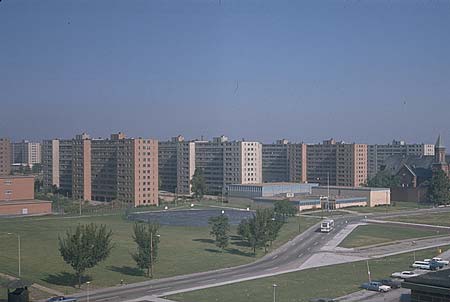
                    startup they seem to come to life, because finally they're working
                    the way people are meant to.<br/><br/><br/><br/><br/><br/><b>Notes</b><br/><br/>[<a name="f1n"><font color="#000000">1</font></a>]
                    When I talk about humans being meant or designed to live a
                    certain way, I mean by evolution.<br/><br/>[<a name="f2n"><font color="#000000">2</font></a>]
                    It's not only the leaves who suffer.  The constraint propagates
                    up as well as down.  So managers are constrained too; instead of
                    just doing things, they have to act through subordinates.<br/><br/>[<a name="f3n"><font color="#000000">3</font></a>]
                    Do not finance your startup with credit cards.  Financing a
                    startup with debt is usually a stupid move, and credit card debt
                    stupidest of all.  Credit card debt is a bad idea, period.  It is
                    a trap set by evil companies for the desperate and the foolish.<br/><br/>[<a name="f4n"><font color="#000000">4</font></a>]
                    The founders we fund used to be younger (initially we encouraged
                    undergrads to apply), and the first couple times I saw this I used
                    to wonder if they were actually getting physically taller.<br/><br/><b>Thanks</b> to Trevor Blackwell, Ross Boucher, Aaron Iba, Abby
                    Kirigin, Ivan Kirigin, Jessica Livingston, and Robert Morris for
                    reading drafts of this.<br/><br/><br clear="all"/></font></p>
</blockquote>
<small>
            
            </small>
</section>
            </content>
        </entry>
    
        <entry>
            <id>https://bloge.li/ideas/2023-08-23</id>
            <link href="https://bloge.li/ideas/2023-08-23"/>
            <title>
                Rick and Morty - Finding Meaning in Life
            </title>
            <published>2023-08-23T00:00:00Z</published>
            <content type="html">
                <section id="idea">
<h2></h2>
<p>
                This short video perfectly captures the central theme of Rick and Morty and thus the main reason I love the show so much.
            </p>
<p>
                See the original: <a href="https://youtu.be/ez1rWBPznEc?si=TP6YegfLw9HdKE30" target="_blank">Rick and Morty - Finding Meaning in Life by Will Schoder</a>
</p>
<p>
                P.S. I've attached another video of, made by this same person, on David Foster Wallace and postmodernism below the first video.
                If you already like Rick and Morty, you will probably like this second video :)
            </p>
<br/><br/>
<video controls="" width="100%">
<source src="../static/ideas/rick-and-morty.mp4#t=0.001" type="video/mp4"/>
                Your browser does not support the video tag.
            </video>
<br/><br/>
<p>
                See the original: <a href="https://youtu.be/2doZROwdte4?si=km-DnkrbeX-cENIT" target="_blank">David Foster Wallace - The Problem with Irony by Will Schoder</a>
</p>
<video controls="" width="100%">
<source src="../static/ideas/david-foster-wallace.mp4#t=0.001" type="video/mp4"/>
                Your browser does not support the video tag.
            </video>
<small>
            
            </small>
</section>
            </content>
        </entry>
    
        <entry>
            <id>https://bloge.li/ideas/2023-07-13</id>
            <link href="https://bloge.li/ideas/2023-07-13"/>
            <title>
                John Cena Reflects on Living Out of His Car
            </title>
            <published>2023-07-13T00:00:00Z</published>
            <content type="html">
                <section id="idea">
<h2></h2>
<p>
                This is really interesting, and exactly the kind of decisions I'm talking about in <a href="../articles/2023-05-28"><i>Crazy or courageous?</i></a>
</p>
<p>
                Can't you imagine all of his friends saying, "Why are you so crazy John?
                Wait you are living out of your car?!"
            </p>
<p>
                And he is going through these hard times <i>by choice</i>.
                I love that.
            </p>
<p>
                Even if we could bring ourselves to take a leap like this, how long could you last?
                Could you take this repeated failure?
                Or would you quit?
            </p>
<p>
                I also love how he casually defends living in his car with, "Well a Lincoln Continental is a big car."
            </p>
<p>
                But seriously, he lived out of his car for 4 months and then out of a garage for 6 more, <i>when he could have went home at any moment.</i>
</p>
<p>
                See the original: <a href="https://youtu.be/WVuDZk3Es3E" target="_blank">An interview on Hart to Heart | Peacock</a>
</p>
<br/><br/>
<video controls="" width="100%">
<source src="../static/ideas/u-cant-see-me.mp4#t=0.001" type="video/mp4"/>
                Your browser does not support the video tag.
            </video>
<div id="ideas-content">
</div>
<small>
            
            </small>
</section>
            </content>
        </entry>
    
        <entry>
            <id>https://bloge.li/ideas/2023-07-4</id>
            <link href="https://bloge.li/ideas/2023-07-4"/>
            <title>
                Douglas Hofstadter changes his mind on Deep Learning and AI risk
            </title>
            <published>2023-07-04T00:00:00Z</published>
            <content type="html">
                <section id="idea">
<h2></h2>
<p>
                I thought this was interesting because when I finished <i>I am a Strange loop</i>, I couldn't find Hofstadter's thoughts on modern LLMs like GPT.
                Here they are.
            </p>
<p>
                See the original: <a href="https://www.lesswrong.com/posts/kAmgdEjq2eYQkB5PP/douglas-hofstadter-changes-his-mind-on-deep-learning-and-ai" target="_blank">An article from Lesswrong</a>
</p>
<br/><br/>
<style>
                body#home div#content ul li::before{
                    content: "";
                    margin-right: 0;
                }
                body#home div#content ul li{
                    padding-left: 0;
                }
            </style>
<blockquote id="ideas-content">
<div class="ContentItemBody-root"><p id="block0"><span><span><span><a href="https://www.youtube.com/watch?v=lfXxzAVtdpU&amp;t=1763s">A podcast interview</a></span></span></span> (posted 2023-06-29) with noted AI researcher Douglas Hofstadter discusses his career and current views on AI.</p>
<p id="block1">Hofstadter has <span><span><span><a href="https://www.economist.com/by-invitation/2022/06/09/artificial-neural-networks-today-are-not-conscious-according-to-douglas-hofstadter">previously</a></span></span></span> <span><span><span><a href="https://www.theatlantic.com/ideas/archive/2023/06/generative-artificial-intelligence-universities/674473/">energetically</a></span></span></span> criticized GPT-2/3 models (and <span><span><span><a href="https://qz.com/1088714/qa-douglas-hofstadter-on-why-ai-is-far-from-intelligent">deep</a></span></span></span> <span><span><span><a href="https://www.theatlantic.com/technology/archive/2018/01/the-shallowness-of-google-translate/551570/">learning</a></span></span></span> and <span><span><span><a href="https://www.theatlantic.com/magazine/archive/2013/11/the-man-who-would-teach-machines-to-think/309529/">compute-heavy GOFAI</a></span></span></span>).
                    These criticisms were widely circulated &amp; cited, and apparently many people found Hofstadter a convincing &amp; trustworthy authority when he was negative on deep learning capabilities &amp; prospects, and so I found his comments in this most recent discussion of considerable interest (via <span><span><span><a href="https://twitter.com/kmett/status/1675378198345834496">Edward Kmett</a></span></span></span>).</p>
<p id="block2">Below I excerpt from the second half where he discusses DL progress &amp; AI risk:</p>
<blockquote id="block3">
<ul>
<li id="block4">
<ul>
<li id="block5">
<p id="block6"><strong>Q</strong>: ...Which ideas from
                    <span><span><span><a href="https://en.wikipedia.org/wiki/G%C3%B6del,_Escher,_Bach"><em>GEB</em></a></span></span></span> are most relevant today?</p>
</li>
<li id="block7">
<p id="block8"><span><span><span><a href="https://en.wikipedia.org/wiki/Douglas_Hofstadter"><strong>Douglas
                    Hofstadter</strong></a></span></span></span>: ...In my book, <span><span><span><a href="https://en.wikipedia.org/wiki/I_Am_a_Strange_Loop"><em>I Am a
                    Strange
                    Loop</em></a></span></span></span>, I tried to set forth what
                    it is that really makes a self or a soul. I like to use the word
                    "soul", not in the religious sense, but as a synonym for "I", a
                    human "I", capital letter "I." So, what is it that makes a human
                    being able to validly say "I"? What justifies the use of that
                    word? When can a computer say "I" and we feel that there is a
                    genuine "I" behind the scenes?</p>
<p id="block9">I don't mean like when you call up the drugstore and the
                    chatbot, or whatever you want to call it, on the phone says,
                    "Tell me what you want. I know you want to talk to a human
                    being, but first, in a few words, tell me what you want. I can
                    understand full sentences." And then you say something and it
                    says, "Do you want to refill a prescription?" And then when I
                    say yes, it says, "Gotcha", meaning "I got you." So it acts as
                    if there is an "I" there, but I don't have any sense whatsoever
                    that there is an "I" there. It doesn't feel like an "I" to me,
                    it feels like a very mechanical process.</p>
<p id="block10">But in the case of more advanced things like
                    <span><span><span><a href="https://openai.com/blog/chatgpt/">ChatGPT</a></span></span></span>-3 or
                    <span><span><span><a href="https://openai.com/research/gpt-4">GPT-4</a></span></span></span>, it feels like there
                    is something more there that merits the word "I." The question
                    is, when will we feel that those things actually deserve to be
                    thought of as being full-fledged, or at least partly fledged,
                    "I"s?</p>
<p id="block11">I personally worry that this is happening right now. But it's
                    not only happening right now. It's not just that certain things
                    that are coming about are similar to human consciousness or
                    human selves. They are also very different, and in one way, it
                    is extremely frightening to me. They are extraordinarily much
                    more knowledgeable and they are extraordinarily much faster. So
                    that if I were to take an hour in doing something, the ChatGPT-4
                    might take one second, maybe not even a second, to do exactly
                    the same thing.</p>
<p id="block12">And that suggests that these entities, whatever you want to
                    think of them, are going to be very soon, right now they still
                    make so many mistakes that we can't call them more intelligent
                    than us, but very soon they're going to be, they may very well
                    be more intelligent than us and far more intelligent than us.
                    And at that point, we will be receding into the background in
                    some sense. We will have handed the baton over to our
                    successors, for better or for worse.</p>
<p id="block13">And I can understand that if this were to happen over a long
                    period of time, like hundreds of years, that might be okay. But
                    it's happening over a period of a few years. It's like a tidal
                    wave that is washing over us at unprecedented and unimagined
                    speeds. And to me, it's quite terrifying because it suggests
                    that everything that I used to believe was the case is being
                    overturned.</p>
</li>
</ul>
</li>
<li id="block14">
<ul>
<li id="block15">
<p id="block16"><strong>Q</strong>: What are some things specifically that terrify you? What
                    are some issues that you're really...</p>
</li>
<li id="block17">
<p id="block18"><strong>D. Hofstadter</strong>: When I started out studying cognitive science
                    and thinking about the mind and computation, you know, this was
                    many years ago, around 1960, and I knew how computers worked and
                    I knew how extraordinarily rigid they were. You made the
                    slightest typing error and it completely ruined your program.
                    Debugging was a very difficult art and you might have to run
                    your program many times in order to just get the bugs out. And
                    then when it ran, it would be very rigid and it might not do
                    exactly what you wanted it to do because you hadn't told it
                    exactly what you wanted to do correctly, and you had to change
                    your program, and on and on.</p>
<p id="block19">Computers were very rigid and I grew up with a certain feeling
                    about what computers can or cannot do. And I thought that
                    artificial intelligence, when I heard about it, was a very
                    fascinating goal, which is to make rigid systems act fluid. But
                    to me, that was a very long, remote goal. It seemed infinitely
                    far away. It felt as if artificial intelligence was the art of
                    trying to make very rigid systems behave as if they were fluid.
                    And I felt that would take enormous amounts of time. I felt it
                    would be hundreds of years before anything even remotely like a
                    human mind would be asymptotically approaching the level of the
                    human mind, but from beneath.</p>
<p id="block20">I never imagined that computers would rival, let alone surpass,
                    human intelligence. And in principle, I thought they could rival
                    human intelligence. I didn't see any reason that they couldn't.
                    But it seemed to me like it was a goal that was so far away, I
                    wasn't worried about it. But when certain systems started
                    appearing, maybe 20 years ago, they gave me pause. And then this
                    started happening at an accelerating pace, where unreachable
                    goals and things that computers shouldn't be able to do started
                    toppling. The defeat of Gary Kasparov by Deep Blue, and then
                    going on to Go systems, Go programs, well, systems that could
                    defeat some of the best Go players in the world. And then
                    systems got better and better at translation between languages,
                    and then at producing intelligible responses to difficult
                    questions in natural language, and even writing poetry.</p>
<p id="block21">And my whole intellectual edifice, my system of beliefs... It's
                    a very traumatic experience when some of your most core beliefs
                    about the world start collapsing. And especially when you think
                    that human beings are soon going to be eclipsed. It felt as if
                    not only are my belief systems collapsing, but it feels as if
                    the entire human race is going to be eclipsed and left in the
                    dust soon. People ask me, "What do you mean by 'soon'?" And I
                    don't know what I really mean. I don't have any way of knowing.
                    But some part of me says 5 years, some part of me says 20 years,
                    some part of me says, "I don't know, I have no idea." But the
                    progress, the accelerating progress, has been so unexpected, so
                    completely caught me off guard, not only myself but many, many
                    people, that there is a certain kind of terror of an oncoming
                    tsunami that is going to catch all humanity off guard.</p>
<p id="block22">It's not clear whether that will mean the end of humanity in the
                    sense of the systems we've created destroying us. It's not clear
                    if that's the case, but it's certainly conceivable. If not, it
                    also just renders humanity a very small phenomenon compared to
                    something else that is far more intelligent and will become
                    incomprehensible to us, as incomprehensible to us as we are to
                    cockroaches.</p>
</li>
<li id="block23">
<p id="block24"><strong>Q</strong>: That's an interesting thought. [nervous laughter]</p>
</li>
<li id="block25">
<p id="block26"><strong>Hofstadter</strong>: Well, I don't think it's interesting. I think
                    it's terrifying. I hate it. I think about it practically all the
                    time, every single day. [<strong>Q</strong>: Wow.] And it overwhelms me and depresses
                    me in a way that I haven't been depressed for a very long time.</p>
</li>
<li id="block27">
<p id="block28"><strong>Q</strong>: Wow, that's really intense. You have a unique
                    perspective, so knowing you feel that way is very powerful.</p>
</li>
</ul>
</li>
<li id="block29">
<ul>
<li id="block30">
<p id="block31"><strong>Q</strong>: How have LLMs, large language models, impacted your view
                    of how human thought and creativity works?</p>
</li>
<li id="block32">
<p id="block33"><strong>D H</strong>: Of course, it reinforces the idea that human creativity
                    and so forth come from the brain's hardware. There is nothing
                    else than the brain's hardware, which is neural nets. But one
                    thing that has completely surprised me is that these LLMs and
                    other systems like them are all feed-forward. It's like the
                    firing of the neurons is going only in one direction. And I
                    would never have thought that deep thinking could come out of a
                    network that only goes in one direction, out of firing neurons
                    in only one direction. And that doesn't make sense to me, but
                    that just shows that I'm naive.</p>
<p id="block34">It also makes me feel that maybe the human mind is not so
                    mysterious and complex and impenetrably complex as I imagined it
                    was when I was writing <em>Gödel, Escher, Bach</em> and writing <em>I Am a
                    Strange Loop</em>. I felt at those times, quite a number of years
                    ago, that as I say, we were very far away from reaching anything
                    computational that could possibly rival us. It was getting more
                    fluid, but I didn't think it was going to happen, you know,
                    within a very short time.</p>
<p id="block35">And so it makes me feel diminished. It makes me feel, in some
                    sense, like a very imperfect, flawed structure compared with
                    these computational systems that have, you know, a million times
                    or a billion times more knowledge than I have and are a billion
                    times faster. It makes me feel extremely inferior. And I don't
                    want to say deserving of being eclipsed, but it almost feels
                    that way, as if we, all we humans, unbeknownst to us, are soon
                    going to be eclipsed, and rightly so, because we're so imperfect
                    and so fallible. We forget things all the time, we confuse
                    things all the time, we contradict ourselves all the time. You
                    know, it may very well be that that just shows how limited we
                    are.</p>
</li>
</ul>
</li>
<li id="block36">
<ul>
<li id="block37">
<p id="block38"><strong>Q</strong>: Wow. So let me keep going through the questions. Is there
                    a time in our history as human beings when there was something
                    analogous that terrified a lot of smart people?</p>
</li>
<li id="block39">
<p id="block40"><strong>D H</strong>: Fire.</p>
</li>
<li id="block41">
<p id="block42"><strong>Q</strong>: You didn't even hesitate, did you? So what can we learn
                    from that?</p>
</li>
<li id="block43">
<p id="block44"><strong>D H</strong>: No, I don't know. Caution, but you know, we may have
                    already gone too far. We may have already set the forest on
                    fire. I mean, it seems to me that we've already done that. I
                    don't think there's any way of going back.</p>
<p id="block45">When I saw an interview with <span><span><span><a href="https://en.wikipedia.org/wiki/Geoff_Hinton">Geoff
                    Hinton</a></span></span></span>, who was probably the most
                    central person in the development of all of these kinds of
                    systems, he said something striking. He said he might regret his
                    life's work. He said, "Part of me regrets all of my life's
                    work." The interviewer then asked him how important these
                    developments are. "Are they as important as the <span><span><span><a href="https://en.wikipedia.org/wiki/Industrial_Revolution">Industrial
                    Revolution</a></span></span></span>? Is there something
                    analogous in history that terrified people?" Hinton thought for
                    a second and he said, "Well, maybe as important as the wheel."</p>
</li>
</ul>
</li>
</ul>
</blockquote>
</div>
</blockquote>
<small>
            
            </small>
</section>
            </content>
        </entry>
    
        <entry>
            <id>https://bloge.li/ideas/2023-07-3</id>
            <link href="https://bloge.li/ideas/2023-07-3"/>
            <title>
                What does Geoffrey Hinton believe about AGI existential risk?
            </title>
            <published>2023-07-03T00:00:00Z</published>
            <content type="html">
                <section id="idea">
<h2></h2>
<p>
                Pretty interesting to see what the OGs of AI are thinking.
            </p>
<p>
                See the original: <a href="https://www.newstatesman.com/long-reads/2023/06/men-made-future-godfathers-ai-geoffrey-hinton-yann-lecun-yoshua-bengio-artificial-intelligence" target="_blank">An article from newstatesman.com</a>
</p>
<p>
                See where I found this: <a href="https://marginalrevolution.com/marginalrevolution/2023/06/what-does-geoffrey-hinton-believe-about-agi-existential-risk.html" target="_blank">An article from Tyler Cowen's Marginal Revolution blog</a>
</p>
<br/><br/>
<blockquote id="ideas-content">
<p>I asked Hinton for the strongest argument against his own position [on AGI risk]. “Yann thinks its rubbish,” he replied. “It’s all a question of whether you think that when ChatGPT says something, it understands what it’s saying. I do.”</p>
<p>There are, he conceded, aspects of the world ChatGPT is describing that it does not understand. But he rejected LeCun’s belief that you have to “act on” the world physically in order to understand it, which current AI models cannot do. (“That’s awfully tough on astrophysicists. They can’t act on black holes.”) Hinton thinks such reasoning quickly leads you towards what he has described as a “pre-scientific concept”: consciousness, an idea he can do without. “Understanding isn’t some kind of magic internal essence. It’s an updating of what it knows.”</p>
<p>In that sense, he thinks ChatGPT understands just as humans do. It absorbs data and adjusts its impression of the world. But there is nothing else going on, in man or machine.</p>
<p>“I believe in [the philosopher Ludwig] Wittgenstein’s position, which is that there is no ‘inner theatre’.” If you are asked to imagine a picnic on a sunny day, Hinton suggested, you do not see the picnic in an inner theatre inside your head; it is something conjured by your perceptual system in response to a demand for data. “There is no mental stuff as opposed to physical stuff.” There are “only nerve fibres coming in”. All we do is react to sensory input.</p>
<p>The difference between us and current AIs, Hinton thinks, is the range of input.</p>
</blockquote>
<small>
            
            </small>
</section>
            </content>
        </entry>
    
        <entry>
            <id>https://bloge.li/ideas/2023-06-29</id>
            <link href="https://bloge.li/ideas/2023-06-29"/>
            <title>
                The seduction of grad school
            </title>
            <published>2023-06-29T00:00:00Z</published>
            <content type="html">
                <section id="idea">
<h2></h2>
<p>
                This is something those who are about to graduate soon should consider.
            </p>
<p>
                See the original: <a href="https://seths.blog/2023/06/the-seduction-of-grad-school/" target="_blank">A blog post by Seth Godin</a>
</p>
<br/><br/>
<blockquote id="ideas-content">
<p>For a certain cohort of high-performing students at famous colleges, graduate school feels irresistible.</p>
<p>If you’re good at school, the challenge and offer of law school, med school or a famous business school means you get to do more of what you’re good at. You’re offered a high-status badge, a path to a well-paid job and several years of more school instead of the scary freedom of choice of what happens next.</p>
<p>And so, literate and passionate young people talk about their dreams of helping people, running for office, fighting injustice or exploring their passions as entrepreneurs. And grad school is supposed to be the path.</p>
<p>The problem is that these graduate schools aren’t optimized for any of those things.</p>
<p>Leaving medical school with a pile of debt and your twenties mostly gone pushes you to sign up for the doctor track, which is increasingly about systems and forms, not actually engaging with patients. Law students who came in with dreams of social justice often postpone these dreams for decades as they work for big money at big firms for long hours… You get the idea.</p>
<p>If you want to sit with someone and help them, a career as an occupational or physical therapist is certainly more hands on and direct. If you want to make a difference by writing or arguing, three years of law school and a bar exam aren’t the most leveraged ways to do that. And entrepreneurs need to know a lot, but not what they teach in a typical MBA program.</p>
<p>The stratified work of big name investment banks, consultants, law firms and fancy doctoring is increasingly veering away from the actual contributions of people who have an impact that they can measure and be proud of.</p>
<p>If that sort of work is for you, go for it. But do it with intent.</p>
<p>If not, then perhaps it makes sense to start on the work right this minute. Not with a full certification or permit, but simply creating the sort of change you seek to make, in small steps, right now.</p>
</blockquote>
<small>
            
            </small>
</section>
            </content>
        </entry>
    
        <entry>
            <id>https://bloge.li/ideas/2023-06-18</id>
            <link href="https://bloge.li/ideas/2023-06-18"/>
            <title>
                A single family... High school? (My dreamhome)
            </title>
            <published>2023-06-18T00:00:00Z</published>
            <content type="html">
                <section id="idea">
<h2></h2>
<p>
                I would absolutley love to live/start a business out of a building like this.
                I'm not sure why, but I find this place very cool.
                Maybe because it is big, cheap, and abnormal?
            </p><p>
                (Obviously this one needs some cleanup lol.)
            </p><p>
                I saw this on <a href="https://www.zillow.com/homedetails/450-McCorkle-Ave-Burbank-OK-74633/326907549_zpid/?utm_campaign=iosappmessage&amp;utm_medium=referral&amp;utm_source=txtshare" target="_blank">Zillow</a>.
            </p><p>
                It is an old high school listed for $60,000 with 17,000 sqft 5 bedrooms and 2 bathrooms.
            </p>
<div id="gallery">
<div>
<a href="../static/dreamhome/1.webp">
<img src="../static/dreamHome/1.webp"/>
</a>
</div>
<div>
<a href="../static/dreamHome/2.webp">
<img src="../static/dreamHome/2.webp"/>
</a>
</div>
<div>
<a href="../static/dreamHome/3.webp">
<img src="../static/dreamHome/3.webp"/>
</a>
</div>
<div>
<a href="../static/dreamHome/4.webp">
<img src="../static/dreamHome/4.webp"/>
</a>
</div>
<div>
<a href="../static/dreamHome/5.webp">
<img src="../static/dreamHome/5.webp"/>
</a>
</div>
<div>
<a href="../static/dreamHome/6.webp">
<img src="../static/dreamHome/6.webp"/>
</a>
</div>
<div>
<a href="../static/dreamHome/7.webp">
<img src="../static/dreamHome/7.webp"/>
</a>
</div>
<div>
<a href="../static/dreamHome/8.webp">
<img src="../static/dreamHome/8.webp"/>
</a>
</div>
<div>
<a href="../static/dreamHome/9.webp">
<img src="../static/dreamHome/9.webp"/>
</a>
</div>
<div>
<a href="../static/dreamHome/10.webp">
<img src="../static/dreamHome/10.webp"/>
</a>
</div>
<div>
<a href="../static/dreamHome/11.webp">
<img src="../static/dreamHome/11.webp"/>
</a>
</div>
<div>
<a href="../static/dreamHome/12.webp">
<img src="../static/dreamHome/12.webp"/>
</a>
</div>
<div>
<a href="../static/dreamHome/13.webp">
<img src="../static/dreamHome/13.webp"/>
</a>
</div>
<div>
<a href="../static/dreamHome/14.webp">
<img src="../static/dreamHome/14.webp"/>
</a>
</div>
<div>
<a href="../static/dreamHome/15.webp">
<img src="../static/dreamHome/15.webp"/>
</a>
</div>
<div>
<a href="../static/dreamHome/16.webp">
<img src="../static/dreamHome/16.webp"/>
</a>
</div>
<div>
<a href="../static/dreamHome/17.webp">
<img src="../static/dreamHome/17.webp"/>
</a>
</div>
<div>
<a href="../static/dreamHome/18.webp">
<img src="../static/dreamHome/18.webp"/>
</a>
</div>
<div>
<a href="../static/dreamHome/19.webp">
<img src="../static/dreamHome/19.webp"/>
</a>
</div>
<div>
<a href="../static/dreamHome/20.webp">
<img src="../static/dreamHome/20.webp"/>
</a>
</div>
<div>
<a href="../static/dreamHome/21.webp">
<img src="../static/dreamHome/21.webp"/>
</a>
</div>
<div>
<a href="../static/dreamHome/22.webp">
<img src="../static/dreamHome/22.webp"/>
</a>
</div>
<div>
<a href="../static/dreamHome/23.webp">
<img src="../static/dreamHome/23.webp"/>
</a>
</div>
<div>
<a href="../static/dreamHome/24.webp">
<img src="../static/dreamHome/24.webp"/>
</a>
</div>
<div>
<a href="../static/dreamHome/25.webp">
<img src="../static/dreamHome/25.webp"/>
</a>
</div>
<div>
<a href="../static/dreamHome/26.webp">
<img src="../static/dreamHome/26.webp"/>
</a>
</div>
<div>
<a href="../static/dreamHome/27.webp">
<img src="../static/dreamHome/27.webp"/>
</a>
</div>
<div>
<a href="../static/dreamHome/28.webp">
<img src="../static/dreamHome/28.webp"/>
</a>
</div>
<div>
<a href="../static/dreamHome/29.webp">
<img src="../static/dreamHome/29.webp"/>
</a>
</div>
<div>
<a href="../static/dreamHome/30.webp">
<img src="../static/dreamHome/30.webp"/>
</a>
</div>
<div>
<a href="../static/dreamHome/31.webp">
<img src="../static/dreamHome/31.webp"/>
</a>
</div>
<div>
<a href="../static/dreamHome/32.webp">
<img src="../static/dreamHome/32.webp"/>
</a>
</div>
<div>
<a href="../static/dreamHome/33.webp">
<img src="../static/dreamHome/33.webp"/>
</a>
</div>
</div>
<small>
            
            </small>
</section>
            </content>
        </entry>
    
        <entry>
            <id>https://bloge.li/ideas/2023-05-26</id>
            <link href="https://bloge.li/ideas/2023-05-26"/>
            <title>
                Cosmic Insignificance Therapy
            </title>
            <published>2023-05-26T00:00:00Z</published>
            <content type="html">
                <section id="idea">
<h2></h2>
<blockquote id="ideas-content">
<p>
                This is for all the people who feel anxious about being insignificant, who are worried that they aren't living up to some of history's greatest achievers.
            </p>
<p>
                TLDR; By accepting our meaninglessness, we do more meaningful things.
            </p>
<p>
                I actually found this chapter on the Tim Ferris blog.
                It was so good I'm sharing it here as well.
            </p>
<p>
                See the book: <a href="https://www.amazon.com/Four-Thousand-Weeks-Management-Mortals/dp/0374159122?tag=offsitoftimfe-20" target="_blank">Four Thousand Weeks: Time Management for Mortals by Oliver Burkeman</a>
</p>
<p>
            The Jungian psychotherapist James Hollis recalls the experience of one of his patients, a successful vice president of a medical instruments company, who was flying over the American Midwest on a business trip, reading a book, when she was accosted by a thought: “I hate my life.” A malaise that had been growing in her for years had crystallized in the understanding that she was spending her days in a way that no longer felt as if it had any meaning. The relish she’d had for her work had drained away, the rewards she’d been pursuing seemed worthless, and now life was a matter of going through the motions, in the fading hope that it somehow all might yet pay off in future happiness.
            
            Perhaps you know how she felt. Not everyone has this kind of sudden epiphany, but many of us know what it is to suspect that there might be richer, fuller, juicier things we could be doing with our four thousand weeks—even when what we’re currently doing with them looks, from the outside, like the definition of success. Or maybe you’re familiar with the experience of returning to your daily routines, following an unusually satisfying weekend in nature or with old friends, and being struck by the thought that more of life should feel that way—that it wouldn’t be unreasonable to expect the deeply engrossing parts to be more than rare exceptions. The modern world is especially lacking in good responses to such feelings: religion no longer provides the universal ready-made sense of purpose it once did, while consumerism misleads us into seeking meaning where it can’t be found. But the sentiment itself is an ancient one. The writer of the book of Ecclesiastes, among many others, would instantly have recognized the suffering of Hollis’s patient: “Then I considered all that my hands had done, and the toil I had spent in doing it, and behold, all was vanity and a striving after wind, and there was nothing to be gained under the sun.”
            
            It’s deeply unsettling to find yourself doubting the point of what you’re doing with your life. But it isn’t actually a bad thing because it demonstrates that an inner shift has already occurred. You couldn’t entertain such doubts in the first place if you weren’t already occupying a new vantage point on your life—one from which you’d already begun to face the reality that you can’t depend on fulfillment arriving at some distant point in the future, once you’ve gotten your life in order or met the world’s criteria for success, and that instead the matter needs addressing now. To realize midway through a business trip that you hate your life is already to have taken the first step into one you don’t hate—because it means you’ve grasped the fact that these are the weeks that are going to have to be spent doing something worthwhile if your ﬁnite life is to mean anything at all. This is a perspective from which you can finally ask the most fundamental question of time management: What would it mean to spend the only time you ever get in a way that truly feels as though you are making it count?
            </p>
<h3>
            The Great Pause
            </h3>
<p>
            Sometimes this perceptual jolt affects a whole society at once. I wrote the first draft of this chapter under lockdown in New York City during the coronavirus pandemic, when, amid the grief and anxiety, it became normal to hear people express a sort of bittersweet gratitude for what they were experiencing: that even though they were furloughed and losing sleep about the rent, it was a genuine joy to see more of their children or to rediscover the pleasures of planting flowers or baking bread. The enforced pause in work, school, and socializing put on hold numerous assumptions about how we had to spend our time. It turned out, for example, that many people could perform their jobs adequately without an hour-long commute to a dreary office or remaining at a desk until 6:30 p.m. solely in order to appear hardworking. It also turned out that most of the restaurant meals and takeout coffees I’d grown accustomed to consuming, presumably on the grounds that they enhanced my life, could be forsworn with no feeling of loss (a double-edged revelation, given how many jobs depended on providing them). And it became clear—from the ritual applauding of emergency workers, grocery runs undertaken for housebound neighbors, and many other acts of generosity—that people cared about one another far more than we’d assumed. It was just that before the virus, apparently, we hadn’t had the time to show it.
            
            Things hadn’t changed for the better, obviously. But alongside the devastation that it wrought, the virus changed us for the better, at least temporarily, and at least in certain respects: it helped us perceive more clearly what our pre-lockdown days had been lacking and the trade-oﬀs we’d been making, willingly or otherwise—for example, by pursuing work lives that left no time for neighborliness. A New York writer and director named Julio Vincent Gambuto captured this sense of what I found myself starting to think of as “possibility shock”—the startling understanding that things could be different, on a grand scale, if only we collectively wanted that enough. “What the trauma has shown us,” Gambuto wrote, “cannot be unseen. A carless Los Angeles has clear blue skies, as pollution has simply stopped. In a quiet New York, you can hear the birds chirp in the middle of Madison Avenue. Coyotes have been spotted on the Golden Gate Bridge. These are the postcard images of what the world might be like if we could find a way to have a less deadly effect on the planet.” Of course, the crisis also revealed underfunded healthcare systems, venal politicians, deep racial inequities, and chronic economic insecurity. But these, too, contributed to the feeling that now we were seeing what actually mattered, what demanded our attention—and that on some level we’d known it all along.
            
            When lockdown ended, Gambuto warned, corporations and governments would conspire to make us forget the possibilities we’d glimpsed, by means of shiny new products and services and distracting culture wars, and we’d be so desperate to return to normality that we’d be tempted to comply. Instead, though, we could hold on to the sense of strangeness and make new choices about how we used the hours of our lives:
            
            What happened is inexplicably incredible. It’s the greatest gift ever unwrapped. Not the deaths, not the virus, but The Great Pause. . . . Please don’t recoil from the bright light beaming through the window. I know it hurts your eyes. It hurts mine, too. But the curtain is wide open. . . . The Great American Return to Normal is coming . . . [but] I beg of you: take a deep breath, ignore the deafening noise, and think deeply about what you want to put back into your life. This is our chance to define a new version of normal, a rare and truly sacred (yes, sacred) opportunity to get rid of the bullshit and to only bring back what works for us, what makes our lives richer, what makes our kids happier, what makes us truly proud.
            
            The hazard in any such discussion of “what matters most” in life, though, is that it tends to give rise to a kind of paralyzing grandiosity. It starts to feel as though it’s your duty to find something truly consequential to do with your time—to quit your office job to become an aid worker or start a space flight company—or else, if you’re in no position to make such a grand gesture, to conclude that a deeply meaningful life isn’t an option for you. On the level of politics and social change, it becomes tempting to conclude that only the most revolutionary, world-transforming causes are worth fighting for—that it would be meaningless to spend your time, say, caring for an elderly relative with dementia or volunteering at the local community garden while the problems of global warming and income inequality remain unsolved. Among New Age types, this same grandiosity takes the form of the belief that each of us has some cosmically significant Life Purpose that the universe is longing for us to uncover and then to fulfill.
            
            Which is why it’s useful to begin this last stage of our journey with a blunt but unexpectedly liberating truth: that what you do with your life doesn’t matter all that much—and when it comes to how you’re using your ﬁnite time, the universe absolutely could not care less.
            </p>
<h3>
            A Modestly Meaningful Life
            </h3>
<p>
            The late British philosopher Bryan Magee liked to make the following arresting point. Human civilization is about six thousand years old, and we’re in the habit of thinking of this as a staggeringly long time: a vast duration across which empires rose and fell and historical periods to which we give labels such as “classical antiquity” or “the Middle Ages” succeeded each other in “only-just-moving time—time moving in the sort of way a glacier moves.” But now consider the matter a different way. In every generation, even back when life expectancy was much shorter than it is today, there were always at least a few people who lived to the age of one hundred (or 5,200 weeks). And when each of those people was born, there must have been a few other people alive at the time who had already reached the age of one hundred themselves. So it’s possible to visualize a chain of centenarian lifespans stretching all the way back through history with no spaces in between them: specific people who really lived, and each of whom we could name, if only the historical record were good enough.
            
            Now for the arresting part: by this measure, the golden age of the Egyptian pharaohs—an era that strikes most of us as impossibly remote from our own—took place a scant thirty-five lifetimes ago. Jesus was born about twenty lifetimes ago, and the Renaissance happened seven lifetimes back. A paltry five centenarian lifetimes ago, Henry VIII sat on the English throne. Five! As Magee observed, the number of lives you’d need in order to span the whole of civilization, sixty, was “the number of friends I squeeze into my living room when I have a drinks party.” From this perspective, human history hasn’t unfolded glacially but in the blink of an eye. And it follows, of course, that your own life will have been a minuscule little flicker of near-nothingness in the scheme of things: the merest pinpoint, with two incomprehensibly vast tracts of time, the past and future of the cosmos as a whole, stretching oﬀ into the distance on either side.
            
            It’s natural to find such thoughts terrifying. To contemplate “the massive indifference of the universe,” writes Richard Holloway, the former bishop of Edinburgh, can feel “as disorienting as being lost in a dense wood or as frightening as falling overboard into the sea with no-one to know we have gone.” But there’s another angle from which it’s oddly consoling. You might think of it as “cosmic insignificance therapy”: When things all seem too much, what better solace than a reminder that they are, provided you’re willing to zoom out a bit, indistinguishable from nothing at all? The anxieties that clutter the average life—relationship troubles, status rivalries, money worries—shrink instantly down to irrelevance. So do pandemics and presidencies, for that matter: the cosmos carries on regardless, calm and imperturbable. Or to quote the title of a book I once reviewed: The Universe Doesn’t Give a Flying Fuck About You. To remember how little you matter, on a cosmic timescale, can feel like putting down a heavy burden that most of us didn’t realize we were carrying in the first place.
            
            This sense of relief is worth examining a little more closely, though, because it draws attention to the fact that the rest of the time, most of us do go around thinking of ourselves as fairly central to the unfolding of the universe; if we didn’t, it wouldn’t be any relief to be reminded that in reality this isn’t the case. Nor is this a phenomenon confined to megalomaniacs or pathological narcissists, but something much more fundamental to being human: it’s the understandable tendency to judge everything from the perspective you occupy, so that the few thousand weeks for which you happen to be around inevitably come to feel like the linchpin of history to which all prior time was always leading up. These self-centered judgments are part of what psychologists call the “egocentricity bias,” and they make good sense from an evolutionary standpoint. If you had a more realistic sense of your own sheer irrelevance, considered on the timescale of the universe, you’d probably be less motivated to struggle to survive and thereby to propagate your genes.
            
            You might imagine, moreover, that living with such an unrealistic sense of your own historical importance would make life feel more meaningful by investing your every action with a feeling of cosmic significance, however unwarranted. But what actually happens is that this overvaluing of your existence gives rise to an unrealistic definition of what it would mean to use your ﬁnite time well. It sets the bar much too high. It suggests that in order to count as having been “well spent,” your life needs to involve deeply impressive accomplishments or that it should have a lasting impact on future generations—or at the very least that it must, in the words of the philosopher Iddo Landau, “transcend the common and the mundane.” Clearly, it can’t just be ordinary: After all, if your life is as significant in the scheme of things as you tend to believe, how could you not feel obliged to do something truly remarkable with it?
            
            This is the mindset of the Silicon Valley tycoon determined to “put a dent in the universe” or the politician fixated on leaving a legacy or the novelist who secretly thinks her work will count for nothing unless it reaches the heights, and the public acclaim, of Leo Tolstoy’s. Less obviously, though, it is also the implicit outlook of those who glumly conclude that their life is ultimately meaningless, and that they’d better stop expecting it to feel otherwise. What they really mean is that they’ve adopted a standard of meaningfulness to which virtually nobody could ever measure up. “We do not disapprove of a chair because it cannot be used to boil water for a nice cup of tea,” Landau points out: a chair just isn’t the kind of thing that ought to have the capacity to boil water, so it isn’t a problem that it doesn’t. And it is likewise “implausible, for almost all people, to demand of themselves that they be a Michelangelo, a Mozart, or an Einstein. . . . There have only been a few dozen such people in the entire history of humanity.” In other words, you almost certainly won’t put a dent in the universe. Indeed, depending on the stringency of your criteria, even Steve Jobs, who coined that phrase, failed to leave such a dent. Perhaps the iPhone will be remembered for more generations than anything you or I will ever accomplish, but from a truly cosmic view, it will soon be forgotten, like everything else.
            
            No wonder it comes as a relief to be reminded of your insignificance: it’s the feeling of realizing that you’d been holding yourself, all this time, to standards you couldn’t reasonably be expected to meet. And this realization isn’t merely calming but liberating, because once you’re no longer burdened by such an unrealistic definition of a “life well spent,” you’re freed to consider the possibility that a far wider variety of things might qualify as meaningful ways to use your ﬁnite time. You’re freed, too, to consider the possibility that many of the things you’re already doing with it are more meaningful than you’d supposed—and that until now, you’d subconsciously been devaluing them on the grounds that they weren’t “significant” enough.
            
            From this new perspective, it becomes possible to see that preparing nutritious meals for your children might matter as much as anything could ever matter, even if you won’t be winning any cooking awards; or that your novel’s worth writing if it moves or entertains a handful of your contemporaries, even though you know you’re no Tolstoy; or that virtually any career might be a worthwhile way to spend a working life if it makes things slightly better for those it serves. Furthermore, it means that if what we learn from the experience of the coronavirus pandemic is to become just a little more attuned to the needs of our neighbors, we’ll have learned something valuable as a result of the “Great Pause,” no matter how far oﬀ the root-and-branch transformation of society remains.
            
            Cosmic insignificance therapy is an invitation to face the truth about your irrelevance in the grand scheme of things. To embrace it, to whatever extent you can. (Isn’t it hilarious, in hindsight, that you ever imagined things might be otherwise?) Truly doing justice to the astonishing gift of a few thousand weeks isn’t a matter of resolving to “do something remarkable” with them. In fact, it entails precisely the opposite: refusing to hold them to an abstract and over-demanding standard of remarkableness, against which they can only ever be found wanting, and taking them instead on their own terms, dropping back down from godlike fantasies of cosmic significance into the experience of life as it concretely, finitely—and often enough, marvelously—really is. 
            </p>
</blockquote>
<small>
            
            </small>
</section>
            </content>
        </entry>
    
        <entry>
            <id>https://bloge.li/ideas/2023-03-23</id>
            <link href="https://bloge.li/ideas/2023-03-23"/>
            <title>
                Greatness
            </title>
            <published>2023-03-23T00:00:00Z</published>
            <content type="html">
                <section id="idea">
<h2></h2>
<p>
                See the book: <a href="https://www.amazon.com/Creative-Act-Way-Being/dp/0593652886" target="_blank">The Creative Act by Rick Rubin</a>
</p>
<blockquote id="ideas-content">
<p>
                 Imagine going to live on a mountaintop by yourself, forever. You build a home that no one will ever visit. Still, you invest the time and effort to shape the space in which you’ll spend your days.
                <br/> The wood, the plates, the pillows—all magnificent. Curated to your taste.
                <br/> This is the essence of great art. We make it for no other purpose than creating our version of the beautiful, bringing all of ourself to every project, whatever its parameters and constraints. Consider it an offering, a devotional act. We do the best, as we see the best—with our own taste. No one else’s.
                <br/> We create our art so we may inhabit it ourselves.
                <br/> Measurement of greatness is subjective, like art itself. There is no hard metric. We are performing for an audience of one.
                <br/> If you think, “I don’t like it but someone else will, you are not making art for yourself. You’ve found yourself in the business of commerce, which is fine; it just may not be art. There’s no bright line between the two. The more formulaic your creation is, the more it hugs the shore of what’s been popular, the less like art it’s likely to be. And in fact, creativity in that spirit often fails even at its own goals. There is no more valid metric to predict what someone else might enjoy than us liking it ourselves.
			    <br/> Fear of criticism. Attachment to a commercial result. Competing with past work. Time and resource constraints. The aspiration of wanting to change the world. And any story beyond “I want to make the best thing I can make, whatever it is” are all undermining forces in the quest for greatness.
                <br/> Instead of focusing on what making this will bring you, focus on what you contribute to this art to make it the best it could possibly be, with no limitation.
    			<br/> If you’re creating something with a solely functional purpose, such as a car designed to reach a certain top speed, other intentions may matter. If your project is purely artistic, then redirect your inner voice to focus on pure creative intent.
                <br/> With the objective of simply doing great work, a ripple effect occurs. A bar is set for everything you do, which may not only lift your work to new heights, but raise the vibration of your entire life. It may even inspire others to do their best work. Greatness begets greatness. It’s infectious.
            </p>
</blockquote>
<small>
            
            </small>
</section>
            </content>
        </entry>
    
        <entry>
            <id>https://bloge.li/ideas/2023-02-18</id>
            <link href="https://bloge.li/ideas/2023-02-18"/>
            <title>
                Products don't exist - only brands do
            </title>
            <published>2023-02-18T00:00:00Z</published>
            <content type="html">
                <section id="idea">
<h2></h2>
<p>
                Why did Liquid Death work?
            </p>
<ol>
<li>It is heathy - for all of the skaters and motocross guys that just wanted water not Redbull.</li>
<li>It is cool - would you pick this or one of the other water brands?</li>
<li>It is better for the environment - you get to feel good about not using plastic at no extra cost.</li>
</ol>
<p>
                And of course they did so many things right.
                For example, establishing a demand before actually buying any product.
            </p>
<p>
                See the original: <a href="https://youtu.be/iXjhNZlqexs" target="_blank">Liquid Death's CEO, Mike Cessario, on his water brand</a>
</p>
<style>
            .video-container {
                position: relative;
                width: 100%;
                padding-bottom: 56.25%;
            }
            .video {
                position: absolute;
                top: 0;
                left: 0;
                width: 100%;
                height: 100%;
                border: 0;
            }
            </style>
<div class="video-container">
<iframe allow="accelerometer; autoplay; clipboard-write; encrypted-media; gyroscope; picture-in-picture; web-share" allowfullscreen="" class="video" frameborder="0" src="https://www.youtube.com/embed/iXjhNZlqexs" title="YouTube video player"></iframe>
</div>
<small>
            
            </small>
</section>
            </content>
        </entry>
    
        <entry>
            <id>https://bloge.li/ideas/2023-02-9</id>
            <link href="https://bloge.li/ideas/2023-02-9"/>
            <title>
                Malcolm Gladwell: On the loveliness of mediocrity
            </title>
            <published>2023-02-09T00:00:00Z</published>
            <content type="html">
                <section id="idea">
<h2></h2>
<p>
                Sometimes I feel like my experience at Astate has been sub-par because there isn't highly ambitious people around every corner, unlike some Ivy League schools and such.
                However, this is an optimistic message arguing the opposite.
                Malcolm believes a mediocre college is great for young people because it allows them to explore.
            </p>
<h2>
                On the loveliness of mediocrity
            </h2>
<p>
                See the original: <a href="https://conversationswithtyler.com/episodes/malcolm-gladwell/" target="_blank">The Conversations With Tyler podcast with guest Malcolm Gladwell</a>
</p>
<blockquote id="ideas-content">
<p><b>COWEN:</b> Let’s say you’re giving advice to the parents and grandparents in the room. You can’t reshape the system, you can’t even control Harvard, but you can tell them what to do for their children. What’s your advice, given all of what you just said?</p>
<p><b>GLADWELL:</b> Well, you should delay specialization as long as possible because prediction is poor, and burnout is as big an issue as poor prediction, early prediction. And I would avoid, I think . . .</p>
<p>The other parallel problem, which I get at in <i>David and Goliath­</i>, is that overly competitive environments at too early an age are really, deeply problematic. I thought about this the other day. I live most of the time upstate in New York, very close to Bard [College]. And I go work out at the Bard gym and I was watching . . . Bard has got, I don’t know, how many students? Is it 2,000? I don’t even know. Some tiny number. And I was watching the Bard lacrosse team work out. And I don’t want to offend anyone who went to Bard.</p>
<p><b>COWEN:</b> They’re not allowed to say, by the way, if they did.</p>
<p>[laughter]</p>
<p><b>GLADWELL:</b> OK. That’s right, they can’t say. They can’t say.</p>
<p>They’re terrible!</p>
<p>[laughter]</p>
<p><b>GLADWELL:</b> I was eyeballing their lacrosse team, and I was like, “Good Lord!” I felt that <i>I</i> could go down there at 52 and make this team. That was my first thought, and my second thought was, “That is so fantastic.” Because what it means is, you can be an ordinary Joe at Bard and play lacrosse.</p>
<p>Now think about that in every different thing. In a school that small, with the exception of the things at which they are . . . there’s probably two or three things at Bard at which they genuinely do excel. I’m sure the drama program or the music program is formidable. But let’s accept, though, any nonspecialty item at Bard is going to be wide open. It’s totally accessible. You want to be in the physics club at Bard, you’re going to be in the physics club at Bard. And that is a massively underrated thing.</p>
<p>In other words, there’s a continuum here, and exclusivity is at one end and opportunity is at the other end. And people constantly are confusing these two things and thinking that in exclusivity and in elite status is opportunity. False. <i>Eventually</i>, that’s where the opportunities lie. They don’t lie there when you’re 16 or 17 when what is required of you is experimentation. If you want your 17-year-old to explore the world, send your 17-year-old to a place where the world can be explored. The world cannot be explored at a super-elite university. It’s impossible.</p>
<p>I talk about in <i>David and Goliath</i>, the phenomenon of very, very, very, very good science and math students going to elite colleges and dropping out at enormously high rates because they’re in the 99th percentile and they’re in a class full of people in the in 99.9th percentile. And when you are in the 99th percentile and you’re up against someone in the 99.99th percentile, you feel stupid. Even though you will never again in your life — unless you want to be an academic at MIT in physics — be surrounded by people that smart. It’s over after that. Then you go back to the real world, and you’re smart again. So why would you artificially put yourself in a situation where you feel so dumb that you stop doing the very thing that you went to school to do? That is bananas. And why this isn’t a fact that people . . .</p>
<p>When I was in college, I went out for the University of Toronto newspaper and they wouldn’t give me a job. It was too hard to get in. They were brilliant people. So what did I do? I wrote for my pathetic joke of a . . . we had a residential college. We put out this joke thing every couple weeks, and it was insanely fun. I could do whatever I wanted, nobody cared. We made up all kinds of crazy . . .</p>
<p>In the end, I had a way better experience than I would have had if I was at the highly competitive newspaper. I’ve never forgotten that. By virtue of being this lame, forgotten thing, I got to do more fun stuff and have a much better time than I would have at the proper newspaper. This drives me . . . well, clearly it drives me crazy. I don’t need to say it drives me crazy.</p>
<p>[laughter]</p>
</blockquote>
<small>
            
            </small>
</section>
            </content>
        </entry>
    
        <entry>
            <id>https://bloge.li/ideas/2023-01-26</id>
            <link href="https://bloge.li/ideas/2023-01-26"/>
            <title>
                Non-Traditional living
            </title>
            <published>2023-01-26T00:00:00Z</published>
            <content type="html">
                <section id="idea">
<h2></h2>
<p>
                See the original: <a href="https://youtu.be/pfS-z2omj7Q?t=983" target="_blank">The Rich Roll podcast with Steven Pressfield</a>
</p>
<video controls="" width="100%">
<source src="../static/ideas/fruitTramp.mp4#t=0.001" type="video/mp4"/>
                Your browser does not support the video tag.
            </video>
<small>
            
            </small>
</section>
            </content>
        </entry>
    
        <entry>
            <id>https://bloge.li/ideas/2023-01-14</id>
            <link href="https://bloge.li/ideas/2023-01-14"/>
            <title>
                The end of the high school essay
            </title>
            <published>2023-01-14T00:00:00Z</published>
            <content type="html">
                <section id="idea">
<h2></h2>
<p>
                See the original: <a href="https://seths.blog/2023/01/the-end-of-the-high-school-essay/" target="_blank">A blog post by Seth Godin</a>
</p>
<small>
            
            </small>
</section>
            </content>
        </entry>
    
        <entry>
            <id>https://bloge.li/ideas/2022-12-26</id>
            <link href="https://bloge.li/ideas/2022-12-26"/>
            <title>
                Fisherman Parable
            </title>
            <published>2022-12-26T00:00:00Z</published>
            <content type="html">
                <section id="idea">
<h2></h2>
<img alt="fisherman" src="../static/ideas/fisherman.jpeg" style="width:100%"/>
<small>
            
            </small>
</section>
            </content>
        </entry>
    </feed>